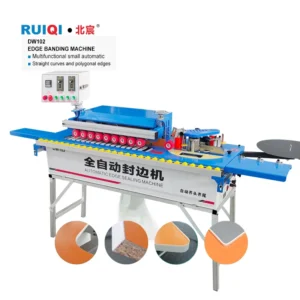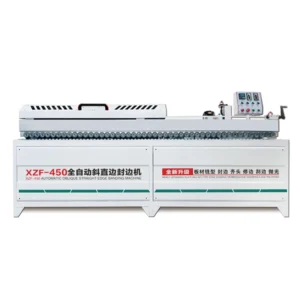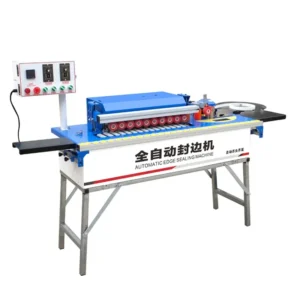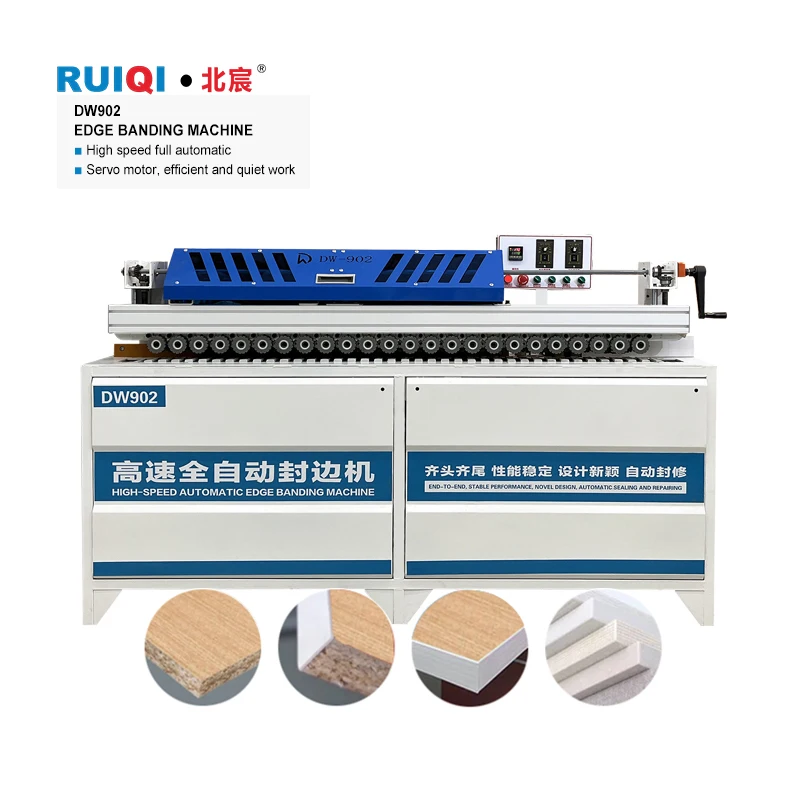
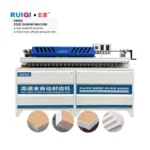
DW902 Automatic Edge Banding Machine, 4000W, 0.3–3mm Banding Thickness — integrates edge banding, trimming, polishing and scraping into a single station for MDF, particleboard and plywood processing. Configured for production line throughput matching between upstream panel saws and downstream boring stations, with dual hot air design ensuring consistent glue activation across materials.
Supported by in-house manufacturing with patented cutting mechanisms and four-stage QC including pre-shipment verification, ensuring tolerance and integration compatibility across your line.
Throughput-matched layout — every DW902 configuration is planned against your upstream panel saw feed rate and downstream boring cycle before the order is confirmed, preventing the bottleneck I have seen freeze an entire line in Ningjin workshops.
| Parameter | Value |
|---|---|
| Model | DW902 |
| Product Type | Automatic Edge Banding Machine |
| Total Power | 4000W |
| Voltage Options | 220V / 380V / customizable range |
| Edge Banding Height | 5CM |
| Edge Banding Thickness Range | 0.3–3MM |
| Minimum Sheet Length | 25CM |
| Minimum Sheet Width | 10CM |
| Trimming Power | 800W × 2 motors |
| Trimming Spindle Speed | 24000 r/min |
| Polishing Power | 380W × 2 motors |
| Edge Power | 140W |
| Transmission Power | 140W |
| Vacuum Power | 550W |
| Air Source Pressure | 0.5–0.8 MPa |
| Glue Pot Capacity | 4000 ml |
| Standard Functions | Edge banding, trimming, polishing, automatic trimming, scraping, vacuuming |
| Machine Dimensions | 175 × 87 × 112 CM |
| Machine Weight | 240 KG |
| Assembly State | Fully assembled before dispatch (basis not stated in source) |
| Application | Material or Output |
|---|---|
| Cabinet door edge finishing | MDF with PVC or melamine edge banding |
| Custom furniture panel edging | Particleboard with 0.3–3MM veneer or ABS |
| Plywood carcass production | Plywood panels for structural cabinet components |
| Ecological board processing | Laminated ecological board for home decoration |
| Solid wood panel edging | Solid wood boards up to 5CM edge height |
The DW902 is configured to the exact conveyor height and feed rhythm of your adjacent stations, not sold as an isolated spec sheet.
I once watched a furniture factory in Shandong bring a full automatic edge banding machine production line to a standstill because the edge bander’s infeed table sat 8mm higher than the panel saw’s roller outfeed. Operators had to lift every sheet of particleboard by hand to bridge the gap, and what was supposed to be continuous flow became a manual bottleneck that erased any throughput advantage the machine offered. The DW902 addresses this during the layout phase, before the order is placed, by matching its infeed geometry and feed speed to the panels arriving from your saw and the cycle times demanded by your downstream boring station [NEED_CITE: production line material flow standards for woodworking]. When one station runs faster than the next can accept, panels stack up, glue cools on the pot, and the whole line waits.
The first question I ask when planning an automatic edge banding machine production line is never about the edge bander itself — it is about what feeds it and what comes after. A panel saw cutting 60 sheets per hour requires an edge bander that can accept, process, and discharge at a compatible rate, or you accumulate work-in-progress inventory between stations. The DW902’s 140W transmission motor and feed mechanism are evaluated against your saw’s outfeed speed and your boring machine’s intake cycle to find a balanced rhythm across the entire cell.
Many workshops I work with start with edge banding and add boring or slotting stations months later as order volume grows. The DW902 is positioned within the line layout so that future stations slot in without relocating existing equipment. Its compact footprint of 175 × 87 × 112 CM leaves clearance for additional machines, and the conveyor height is set to a standard that downstream equipment can match when it arrives. This prevents the expensive teardown and re-alignment that happens when early equipment is placed without considering the eventual full line [NEED_CITE: phased investment planning in panel furniture manufacturing].
The DW902 handles edge banding thickness from 0.3 to 3MM across MDF, particleboard, plywood, and solid wood, but the glue behavior on each substrate is different. Particleboard absorbs adhesive faster than MDF due to its porous structure, which affects the open time before the pressure rollers engage. The 4000ml glue pot capacity and dual hot air system maintain consistent glue temperature and activation across these variations, but the operator needs to know which setting corresponds to which material. When I configure a line, the sample test uses the buyer’s actual board stock and banding material, not a generic showroom panel.
The DW902 carries two trimming motors rated at 800W each, running at 24000 r/min, which determines how cleanly the excess banding material is removed at the panel ends and edges. Insufficient trimming speed on 3MM PVC leaves ragged overhang that requires manual cleanup and breaks the line rhythm. Following trimming, two 380W polishing motors smooth the trimmed edge to a finish suitable for visible cabinet components. The scraping station removes residual glue squeeze-out before it cures, which is particularly important on porous substrates like particleboard where dried adhesive interferes with downstream hardware mounting. The vacuum system at 550W captures trimmings and dust at the source rather than letting it accumulate on the conveyor belt and contaminate subsequent panels [NEED_CITE: dust extraction requirements for enclosed woodworking workshops].
Buying an automatic edge banding machine without confirming its place in the production sequence leads to problems that are expensive to reverse. Feed height mismatch forces manual panel handling between stations. Throughput imbalance means one machine runs idle while another is overloaded. Voltage confirmed for the edge bander but not the adjacent boring machine results in a station that cannot start. These are not theoretical failures — they are the callbacks I handle most often when workshops piece together equipment from different suppliers without a unified layout plan [NEED_CITE: common installation failures in small furniture factories].
The DW902 is planned by engineers who have assembled these machines on the factory floor, not quoted from a catalogue. Every configuration starts with your existing or planned upstream and downstream equipment models, feed speeds, and conveyor heights. Voltage is confirmed against your facility supply before production begins, with customization available across the 220V to 380V range and beyond for specific markets. The four-stage quality control process covers incoming materials, in-process assembly, finished product inspection, and a pre-shipment verification run using sample panels. CE declaration and ISO 9001 certification documentation accompanies every order, and factory visits are welcome before commitment.
Send the model and feed rate of your panel saw, the cycle time of your downstream boring or drilling station, and the conveyor height connecting them. Confirm your workshop voltage and frequency, the primary substrates you process, and whether future stations are planned so the layout accommodates expansion. If you want a sample test on your own board stock before shipment, include the material type and edge banding specification with your inquiry.
Q: How does the DW902 throughput match with upstream panel saws and downstream boring machines?
A: We review your saw’s outfeed rate and boring machine cycle time during configuration to balance material flow across the cell. The DW902’s feed speed and conveyor height are set to prevent accumulation between stations, so no single machine becomes a bottleneck that stalls the rest of the line.
Q: What voltage configurations are available and how is this confirmed before production?
A: The DW902 supports 220V, 380V, and custom voltage and frequency combinations for specific export markets. We confirm your facility’s electrical supply during the quotation phase and lock the specification before production begins, preventing the situation where a machine arrives and cannot be powered on.
Q: Can the DW902 be part of a phased production line investment?
A: Yes. The layout is planned with future station positions reserved, so boring, slotting, or additional edge processing equipment can be added later without relocating the DW902. Conveyor height is set to a standard that downstream machines can match when they are installed.
Q: What materials can be tested during the pre-shipment sample run?
A: We run your actual substrate — MDF, particleboard, plywood, or solid wood — with your specified edge banding material and thickness. The sample panels are photographed and shipped with the machine so you have a baseline for edge quality when commissioning begins at your facility.
Q: How is the production line layout planned for feed height compatibility?
A: We take the conveyor height and infeed geometry of your existing or planned adjacent equipment and set the DW902’s table height to match. This eliminates manual panel lifting between stations, which is the most common cause of throughput loss in small furniture production lines.
* Detailed technical specifications vary by model. Contact us for the full parameter sheet and customization options.
Heavy-duty wooden crate with moisture-proof lining and steel strapping. Seaworthy standard for safe ocean freight.
Standard models: 15-20 working days. Custom OEM orders: 25-35 working days from deposit confirmation.
FOB Qingdao / Tianjin. EXW, CIF available. T/T, L/C, Western Union accepted. Flexible payment terms for long-term partners.
We export to 100+ countries across Europe (Germany, Spain, Italy), Americas (USA, Mexico, Brazil, Argentina), Southeast Asia (Vietnam, Indonesia, Thailand), Africa (Nigeria, Egypt, South Africa), and the Middle East. Full customs documentation and export compliance support included.
Your logo on machine body, control panel and packaging. Full white-label production available.
Support 110V/60Hz, 220V/50Hz, 380V/50Hz, 440V/60Hz and other local electrical standards.
Modify table size, motor power, cutting capacity and other parameters per your production requirements.
Control panel available in English, Spanish, French, Arabic, Russian and other languages on request.
Custom paint color, machine casing design and aesthetic modifications to match your brand identity.
Bundled tooling sets, spare parts kits, installation tools and custom accessories for your market needs.
Fill in your requirements and our sales team will respond within 24 hours with a formal quotation and full technical specifications.