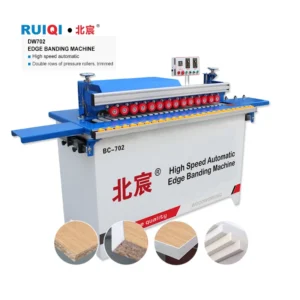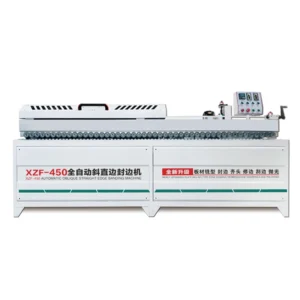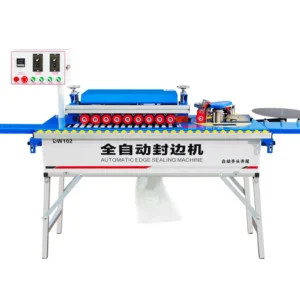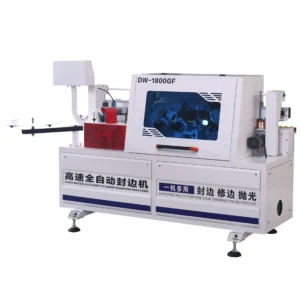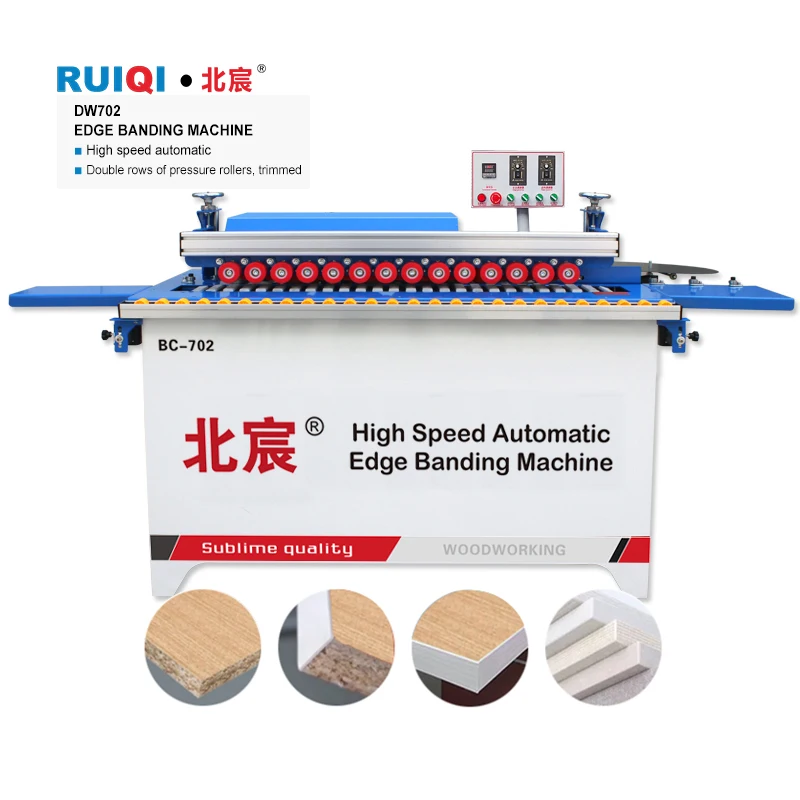
Four-stage QC with pre-shipment verification and factory test records on buyer-specified substrates ensures line-ready delivery.
Validated Line Integration — The DW702 is configured to match feed heights and throughput with adjacent panel processing stations, preventing the production gaps that cause rework downstream.
| Parameter | Value |
|---|---|
| Model | DW702 |
| Product Type | Automatic Edge Banding Machine |
| Total Power | 3800W |
| Voltage | 220V/380V/customization |
| Trimming Power | 800W*2 |
| Polishing Power | 180W*2 |
| Vacuum Power | 1200W |
| Edge Power | 20W |
| Transmission Power | 140W |
| Air Source Pressure | 0.4-0.8Mpa |
| Glue Pot Capacity | 1000ml |
| Edge Banding Height | 0-50MM |
| Edge Banding Thickness | 0.3-3MM |
| Minimum Sheet Length | 25CM |
| Minimum Sheet Width | 10CM |
| Product Size | 12055110CM |
| Product Weight | 105KG |
| Standard Features | Edge banding, trimming, polishing, automatic head and tail, vacuum hold-down |
| Control / Language | Chinese and English standard; Spanish and other languages available on request |
| Plug Options | EU, USA, AU, UK |
| Assembly State | Fully assembled, wooden box packed |
| Application | Material or Output |
|---|---|
| Cabinet door and carcase edge finishing | MDF and particleboard with PVC or melamine edge banding |
| Plywood furniture component edging | Plywood panels with veneer or polymer strip materials |
| Custom panel processing cell integration | Blockboard and wood panels for medium-volume factory runs |
| Polymer door profile edging | Polymer substrates compatible with hot-melt adhesive application |
The tightest edge bander cannot fix a bad cut from the panel saw.
When a workshop buys stations piecemeal without verifying upstream accuracy, the edge bander inherits every error the saw left behind. I once watched a furniture factory feed panels with 1.5 mm edge gaps into an automatic bander — the trimming station worked overtime and still left visible glue lines on MDF substrates. The entire batch of cabinet doors was scrapped. [NEED_CITE: tolerance stack-up between panel saw and edge bander in furniture production]
This is where an edge banding machine production line approach changes the outcome. The DW702 is evaluated not as an isolated unit but as a station that must receive panels within a defined edge straightness tolerance. When the saw and the bander are specified together, feed height alignment and throughput pacing are confirmed before either machine ships.
A common failure in phased line investment is a bottleneck created by mismatched cycle times between stations. The DW702 processes panels within a compact footprint, so its feed rate must be reconciled with the upstream panel saw’s cutting cycles and the downstream boring machine’s indexing speed. When these three stations are configured as a cell, material flow remains steady and panels do not queue on roller conveyors waiting for the next operation. [NEED_CITE: material flow balancing in furniture production cells]
Specifying the edge banding machine production line as a coordinated group means the conveyor heights, panel orientation, and operator access points are planned together. This avoids the situation where a bander arrives and its infeed table sits two centimetres above the saw’s outfeed rollers.
Many cabinet makers start with a panel saw and an edge bander, then add boring and packing stations as volume grows. The DW702’s 120×55×110 cm footprint and standard feed height allow later additions to slot into the existing layout without repositioning the bander or re-pouring floor pads. Voltage and air supply connections are specified with future expansion in mind — the 0.4–0.8 MPa air requirement aligns with a shared workshop compressor that will also serve pneumatic boring heads added in a second phase.
The electrical schematic confirms the breaker capacity and cable routing for the full planned line, not just the machines shipping today. This foresight prevents the costly rewiring that happens when each new station demands its own dedicated circuit panel. [NEED_CITE: electrical load planning for phased machinery installation]
The DW702’s 0.3–3 mm edge banding thickness range covers PVC, melamine, and veneer strips commonly used in cabinet production. Thicker veneer bands require more trimming passes and higher polishing power — the dual 800W trimming motors and dual 180W polishing motors handle this range without stalling on denser materials.
The 1000 ml glue pot capacity suits medium-volume runs where batch changeovers between adhesive colours or formulations occur several times per shift. For lines running a single adhesive continuously, a larger pot would reduce refill interruptions, which is a configuration point worth confirming during line planning.
Vacuum hold-down at 1200W keeps panels flat against the feed chain, which matters most when processing warped particleboard or thin MDF that tends to lift at the trailing edge. Without adequate vacuum, the banding material applies unevenly and the trimming station cuts deeper on one side.
Air source pressure of 0.4–0.8 MPa is standard for workshop compressors shared across multiple pneumatic stations. Confirming that the compressor delivers adequate volume at this pressure — not just peak pressure — prevents pressure drops when the bander and a pneumatic clamp on the boring machine cycle simultaneously.
When an edge bander arrives and its infeed height does not match the upstream saw’s outfeed, operators manually lift panels across the gap — introducing edge damage and inconsistent feed angles that the bander’s pre-milling cannot correct. I have seen this mismatch cause visible seam lines on melamine-faced chipboard that should have been invisible after trimming. [NEED_CITE: consequences of feed height mismatch in panel processing lines]
Equally costly is discovering after installation that the workshop compressor cannot maintain 0.6 MPa when the bander and two boring stations draw air at once. The vacuum hold-down weakens, panels shift during banding, and scrap rates climb. These are line-level failures disguised as edge bander faults.
In-house manufacturing with patented cutting mechanisms means the DW702’s trimming accuracy is verified at the factory, not assumed from a catalogue claim. When ordered as part of a line package, the machine is tested alongside adjacent stations before crating.
Voltage, language, and specification customization is treated as standard configuration rather than a special request — the control panel arrives in the operator’s working language, and the electrical schematic matches the target market’s supply standards.
Engineer-led configuration recommendation means the line layout is reviewed against your floor plan and production volume before a formal quotation is issued, typically within 24 hours. Factory visits are welcomed so buyers can witness the integrated test run on their own substrate and banding material.
Four-stage quality control with pre-shipment verification covers incoming components, in-process assembly, finished product testing, and final inspection before the wooden crate is sealed — reducing the chance of discovering a misaligned trimming head on arrival.
To configure the DW702 within your production flow, share the upstream panel saw model and its outfeed height, the substrates you process most frequently, and the edge banding materials in your current inventory. Confirm your workshop’s available voltage and phase, the compressor’s sustained delivery pressure, and whether additional stations are planned for later phases so the electrical and pneumatic infrastructure can be sized accordingly.
Q: How does the DW702 throughput match with upstream panel saws and downstream boring machines?
A: Feed rate compatibility is evaluated during line configuration so panels move between stations without queuing or starving. The infeed and outfeed heights are aligned with adjacent equipment, and cycle times are balanced so no single machine becomes a bottleneck in the cell.
Q: Can the edge bander be specified now and other stations added later without rework?
A: Yes. The DW702’s footprint, feed height, and utility connections are documented so future boring or packing stations can be positioned alongside without relocating the bander. Electrical and pneumatic capacity is sized for the planned full line from the outset.
Q: What voltage and plug configuration is confirmed before production begins?
A: The buyer’s facility voltage, phase, and frequency are confirmed before the machine is wired. A plug type matching the target market — EU, USA, AU, or UK — is fitted, and an electrical schematic documenting the configuration ships with the machine.
Q: How is the air supply shared with other pneumatic stations on the line?
A: The 0.4–0.8 MPa requirement aligns with standard workshop compressors. During line planning, the compressor’s sustained volume delivery is calculated against all pneumatic stations operating simultaneously to prevent pressure drops during concurrent cycles.
Q: What commissioning support is provided when the machine arrives as part of a full line?
A: Installation guidance covers positioning, utility connections, and initial parameter setting for your specific banding materials. The operator receives training on the control panel in the agreed language, and the trimming and polishing stations are tuned against your production substrates during startup.
* Detailed technical specifications vary by model. Contact us for the full parameter sheet and customization options.
Heavy-duty wooden crate with moisture-proof lining and steel strapping. Seaworthy standard for safe ocean freight.
Standard models: 15-20 working days. Custom OEM orders: 25-35 working days from deposit confirmation.
FOB Qingdao / Tianjin. EXW, CIF available. T/T, L/C, Western Union accepted. Flexible payment terms for long-term partners.
We export to 100+ countries across Europe (Germany, Spain, Italy), Americas (USA, Mexico, Brazil, Argentina), Southeast Asia (Vietnam, Indonesia, Thailand), Africa (Nigeria, Egypt, South Africa), and the Middle East. Full customs documentation and export compliance support included.
Your logo on machine body, control panel and packaging. Full white-label production available.
Support 110V/60Hz, 220V/50Hz, 380V/50Hz, 440V/60Hz and other local electrical standards.
Modify table size, motor power, cutting capacity and other parameters per your production requirements.
Control panel available in English, Spanish, French, Arabic, Russian and other languages on request.
Custom paint color, machine casing design and aesthetic modifications to match your brand identity.
Bundled tooling sets, spare parts kits, installation tools and custom accessories for your market needs.
Fill in your requirements and our sales team will respond within 24 hours with a formal quotation and full technical specifications.