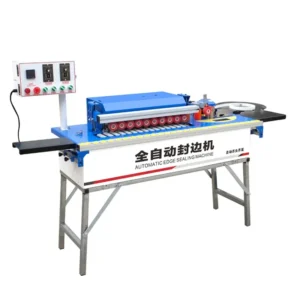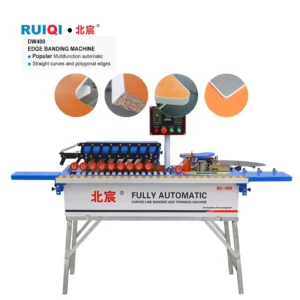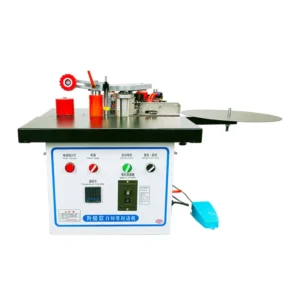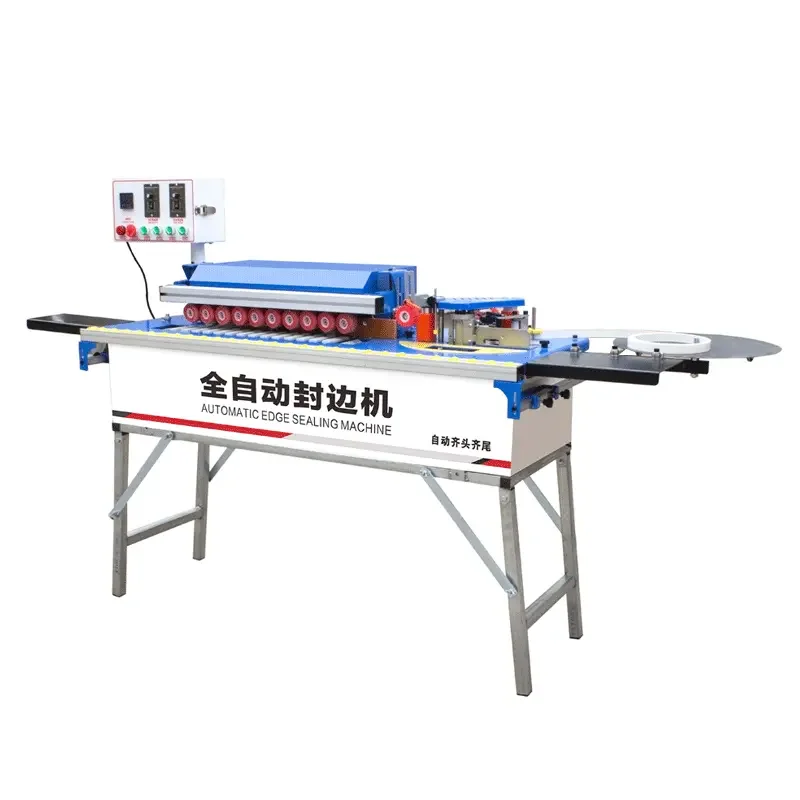
DW102 Automatic Edge Banding Machine, 3800W total power, 0.3–3mm edge thickness range — engineered for phased production line integration where throughput matching between stations is critical.
Engineer-led line configuration with formal quotation within 24 hours ensures this edge bander matches your saw and boring station output from day one.
In-house precision grinding with patented cutting mechanisms — the DW102 edge bander stations in a phased line are built on verified tolerances rather than brochure promises, keeping downstream assembly stations from inheriting edge defects.
| Parameter | Value |
|---|---|
| Model | DW102 |
| Product Type | Automatic Edge Banding Machine |
| Total Power | 3800W |
| Voltage & Frequency | 220V/380V/customization (frequency not stated in source) |
| Overall Dimensions (L×W×H) | 128×47×69 cm |
| Net Weight | 75 kg |
| Minimum Sheet Length | 25 cm |
| Minimum Sheet Width | 5 cm |
| Edge Banding Height Range | 0–50 mm |
| Edge Banding Thickness Range | 0.3–3 mm |
| Trimming Power | 650W×2 |
| Polishing Power | 180W×2 |
| Vacuum Power | 1200W |
| Glue Pot Capacity | 1000 ml |
| Air Source Pressure | 0.5–0.8 MPa |
| Key Features | Curved and straight edge banding, edge trimming, polishing, automatic head and tail cutting, vacuum hold-down |
| Application | Material or Output |
|---|---|
| Furniture panel edge banding | MDF, particleboard, plywood |
| Cabinet component finishing | Blockboard, wood panels |
| Polymer door profile edging | Polymer door substrates with straight and curved profiles |
| Phased line integration | Upstream panel saw output feeding into semi-automated edge processing |
An edge banding machine production line fails the moment one station runs faster than the next can accept.
I spent years doing after-sales repair in the Pearl River Delta, and the most frustrating calls were never about broken machines — they were about machines that worked perfectly in isolation but choked the line once connected. A panel saw cutting forty boards an hour means nothing if the edge bander beside it can only process twenty-five, or if the boring machine downstream expects a feed height the bander cannot match. The DW102 is specified here with its line-fit dimensions and station functions so planners can verify integration before the crate arrives [NEED_CITE: material flow matching principles in panel processing lines].
The DW102 occupies a 128×47×69 cm footprint, which places it between a panel saw and a boring station without requiring a dedicated cell. Its multi-function configuration — straight and curved banding, automatic head-and-tail cutting, trimming, and polishing — means a single station handles tasks that would otherwise require two separate machines on the floor. For factories building an edge banding machine production line in phases, this consolidation reduces the initial capital outlay while leaving room to add pre-milling or corner-rounding stations later.
The critical question is never the bander’s speed in isolation but whether it can absorb the output rhythm of the saw feeding it and release panels at a rate the boring machine can accept. The DW102’s minimum sheet dimensions of 25 cm length and 5 cm width indicate it handles small cabinet components that high-speed saws produce in volume, while the 0–50 mm edge banding height range covers standard panel thicknesses across MDF and particleboard production [NEED_CITE: typical panel thickness standards in furniture manufacturing].
The 3800W total power draw breaks down across six functional groups: two trimming motors at 650W each, two polishing motors at 180W each, a 1200W vacuum system, plus edge and transmission drives. This distribution matters because a shared electrical panel must accommodate the simultaneous draw of all active stations — saw, bander, and boring machine — without tripping breakers during startup surges. The 1000 ml glue pot capacity sets the refill interval; in a continuous run, a smaller pot forces operators to stop the line more frequently, creating a bottleneck that no feed speed can overcome. The 0.5–0.8 MPa air requirement aligns with standard factory compressor output, meaning the DW102 can tap into a shared air supply without a dedicated compressor, provided the existing system has sufficient reserve capacity for all pneumatic stations running simultaneously.
I have watched a furniture factory take delivery of a bander that ran flawlessly on its own, only to discover its output height sat three centimeters below the intake roller of the boring machine next to it. The fix required a custom transfer table, two weeks of fabrication, and idle operators standing around a line that was supposed to be running. These mismatches never show up in a single-machine quotation because nobody asks for the adjacent station’s intake dimensions until the machines are bolted to the floor [NEED_CITE: common installation mismatches in panel processing equipment].
The DW102 belongs to a product family that scales from entry-level to full-function pre-milling configurations, so a workshop can add stations over time without switching suppliers or recalibrating material handoff heights. Voltage is configurable from 220V to 380V with frequency confirmation, preventing the situation where a machine arrives wired for a grid that does not match the local supply. A four-stage quality check — incoming material, in-process, finished product, and pre-shipment verification — runs on every unit before dispatch. Engineer-led configuration recommendations arrive as a formal quotation within 24 hours, including line layout guidance that accounts for upstream and downstream throughput. Factory visits are open for buyers who want to see the DW102 running alongside the saws and boring machines it will join on the floor.
Provide the output rate and panel dimensions from your existing or planned panel saw so the DW102 can be matched to upstream throughput. Specify the local voltage and frequency at your facility to ensure the motor configuration arrives correct. If you are planning a phased build-out, indicate which stations will follow the bander — boring, drilling, or hinge insertion — so transfer heights and conveyor interfaces can be addressed in the initial layout.
Q: How does the DW102 match throughput with upstream saws and downstream boring machines?
A: The DW102’s multi-function station handles banding, trimming, and polishing in one pass, reducing handoff points. Matching requires confirming the panel saw’s output rate and the boring machine’s intake cycle so no station waits or overflows. Provide both numbers during inquiry for a line layout recommendation.
Q: What voltage configurations are available for different regional markets?
A: The DW102 supports 220V and 380V configurations with frequency customization. Confirm your facility’s exact supply before order confirmation to avoid commissioning delays. A mismatch discovered after arrival typically costs weeks to resolve through rewiring or transformer procurement.
Q: Can the DW102 handle curved and straight edges in the same production run?
A: Yes, the machine processes both curved and straight profiles without reconfiguration between panels. This is relevant for cabinet shops running mixed component batches where door fronts require curved edges and side panels require straight edges within the same shift.
Q: What compressed air infrastructure is needed for line integration?
A: The DW102 requires 0.5–0.8 MPa from a shared or dedicated compressor. Verify that your existing system has enough reserve capacity when all pneumatic stations on the line run simultaneously, rather than checking the bander’s requirement in isolation.
Q: How do I plan a phased investment starting with this edge bander?
A: Begin with the DW102 as your first automation station, then add pre-milling or corner-rounding modules as volume grows. Because the machine belongs to a scalable product family, subsequent stations align in feed height and control interface without requiring a full line replacement.
* Detailed technical specifications vary by model. Contact us for the full parameter sheet and customization options.
Heavy-duty wooden crate with moisture-proof lining and steel strapping. Seaworthy standard for safe ocean freight.
Standard models: 15-20 working days. Custom OEM orders: 25-35 working days from deposit confirmation.
FOB Qingdao / Tianjin. EXW, CIF available. T/T, L/C, Western Union accepted. Flexible payment terms for long-term partners.
We export to 100+ countries across Europe (Germany, Spain, Italy), Americas (USA, Mexico, Brazil, Argentina), Southeast Asia (Vietnam, Indonesia, Thailand), Africa (Nigeria, Egypt, South Africa), and the Middle East. Full customs documentation and export compliance support included.
Your logo on machine body, control panel and packaging. Full white-label production available.
Support 110V/60Hz, 220V/50Hz, 380V/50Hz, 440V/60Hz and other local electrical standards.
Modify table size, motor power, cutting capacity and other parameters per your production requirements.
Control panel available in English, Spanish, French, Arabic, Russian and other languages on request.
Custom paint color, machine casing design and aesthetic modifications to match your brand identity.
Bundled tooling sets, spare parts kits, installation tools and custom accessories for your market needs.
Fill in your requirements and our sales team will respond within 24 hours with a formal quotation and full technical specifications.