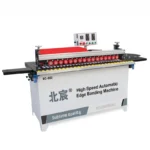
Backed by four-stage QC with pre-shipment factory test records and sample panel verification, so edge quality is confirmed before the machine leaves the floor.
Voltage-Matched Line Integration — configured from the start to align with upstream saws and downstream stations, avoiding the throughput mismatch that stalls panel flow.
| Parameter | Value |
|---|---|
| Model | DW802 |
| Product Type | Automatic Edge Banding Machine |
| Total Power | 4200W |
| Voltage | 220V / 380V / customization |
| Edge Banding Thickness | 0.3–3 mm |
| Edge Banding Height | 0–50 mm |
| Minimum Sheet Length | 250 mm |
| Minimum Sheet Width | 100 mm |
| Glue Pot Capacity | 4000 ml |
| Air Source Pressure | 0.4–0.8 MPa |
| Trimming Power | 800W × 2 |
| Polishing Power | 180W × 2 |
| Vacuum Power | 1200W |
| Edge Power | 140W |
| Transmission Power | 140W |
| Product Size | 130 × 60 × 95 cm |
| Product Weight | 135 kg |
| Language Options | Chinese, English (customizable to Spanish or other languages) |
| Plug Options | EU, USA, AU, UK |
| Assembly State | Fully assembled |
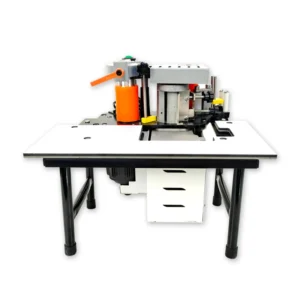
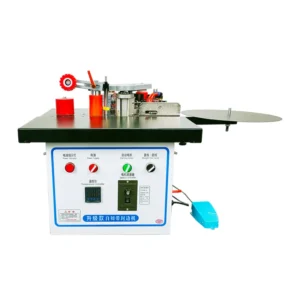
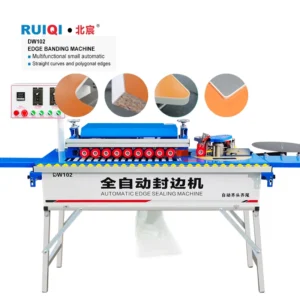
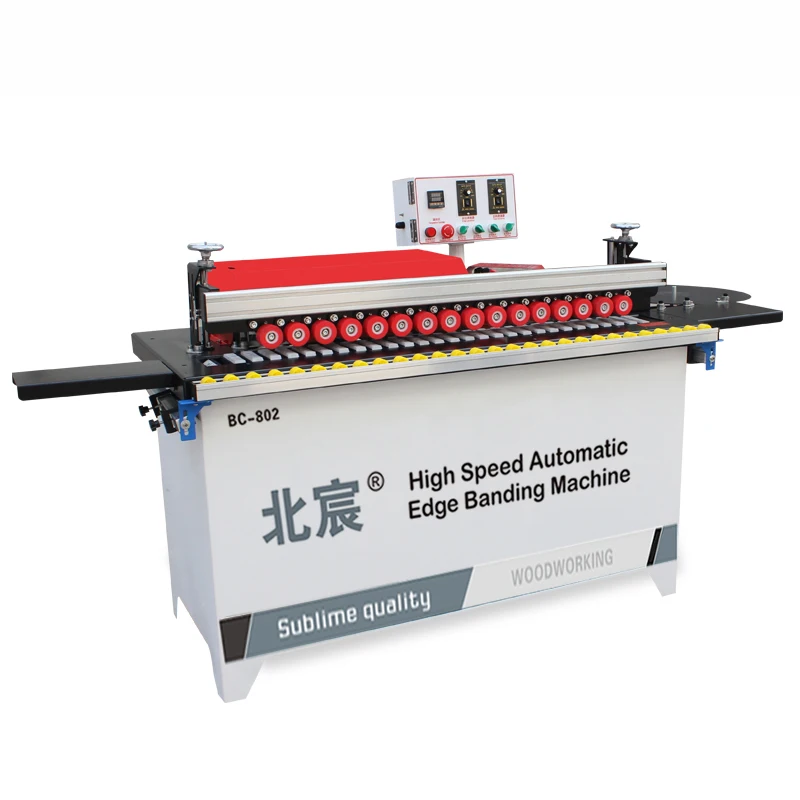
| Key Features | Edge banding, automatic head and tail cutting, trimming, polishing, vacuum extraction |
| Application | Material or Output |
|---|---|
| Custom furniture panel edge sealing | MDF, particleboard, plywood |
| Cabinet door and carcass production | Ecological board, solid wood board |
| Home decoration joinery workshops | PVC and veneer edge banding on panel substrates |
| Phased production line integration | Upstream panel saw output feeding into edge banding station |
An edge banding machine production line only runs as fast as its slowest station allows.
I spent years walking factory floors where a brand-new edge bander sat idle while panels stacked up beside it. The machine was fine on its own. The problem was upstream — a CNC beam saw cutting faster than the bander could accept panels, or a conveyor delivering stock at the wrong height. Operators stood around waiting, and the bottleneck shifted from cutting to edging overnight. That pattern repeats constantly when machines are sourced as standalone units without considering what comes before and after them [NEED_CITE: production line bottleneck analysis in panel furniture manufacturing].
A compact automatic edge banding machine production line starts with realistic expectations about how panels move between stations. The DW802 processes panels down to 250 mm in length and 100 mm in width, which means small cabinet components — drawer sides, shelf brackets, narrow facia strips — can run through without manual intervention. When a cutting station upstream produces panels at a rate the edge bander can absorb, the buffer between them stays manageable and operators are not forced to hand-feed oversize queues.
Voltage mismatches cause more commissioning failures than mechanical defects in my experience. The DW802 is configurable across 220V and 380V supplies, with plug formats for EU, USA, AU, and UK markets. This matters because an edge banding machine production line typically runs several machines on shared bus bars. If one station draws on a different voltage tier than the rest, you either add a transformer or rewire the panel — both of which delay startup and introduce points of failure that have nothing to do with woodworking [NEED_CITE: industrial voltage compatibility standards across export markets].
The 0.3–3 mm edge banding thickness range covers PVC, melamine, and thin veneer strips that most custom furniture factories use daily. Edge height capacity of 0–50 mm handles standard 18 mm board as well as thicker worktop panels. The 4000 ml glue pot supports extended runs without stopping for refills, which keeps the line moving during a full batch of cabinet carcasses. Two trimming motors at 800W each and dual polishing heads at 180W mean the machine finishes the edge in one pass — no secondary station needed to clean up glue lines or trim overhang. For a factory planning an edge banding machine production line, that consolidation of functions into a 130 cm footprint reduces the number of stations you need to power, plumb, and maintain.
Factories that buy an edge bander without mapping material flow often discover the problem weeks after installation. The conveyor height does not match the upstream saw table, so panels jam at the transfer point. The air supply is sized for one machine, but adding a second station drops pressure below the 0.4 MPa minimum and the pneumatic feed stutters. These are not defects in the machine — they are failures in line planning. The cost shows up as idle operators, rework from damaged edges, and emergency calls to electricians and pneumatic fitters [NEED_CITE: compressed air supply sizing for multi-station woodworking lines].
The DW802 ships fully assembled, which eliminates the alignment errors that come from reassembling a precision machine on a factory floor. Voltage and plug configuration are confirmed against your facility’s electrical schematic before production begins, not guessed at the packing stage. Control panel language is set to your operator’s working language — English, Spanish, or another option — so commissioning does not stall over unreadable menus. The four-stage quality check covers incoming components, in-process assembly, finished product function, and a pre-shipment test run with actual panel stock. Patented cutting mechanisms hold edge trimming to tight tolerances that matter when panels move straight from edging to dowel boring in a connected line.
To match this edge bander into your existing workflow, share the upstream saw model and its rated feed rate, the voltage and phase available at the installation point, and the primary board material and thickness you run most often. If you are planning additional stations — a boring machine downstream or a sliding table saw upstream — include those in the conversation early so throughput and transfer heights align before any machine ships.
Q: How does this edge bander’s throughput match with upstream panel saws and downstream boring machines in a full line?
A: Throughput compatibility depends on your specific panel sizes and the feed rates of adjacent stations. We review your upstream saw output and downstream boring cycle times during configuration to confirm the DW802 can absorb panels without creating a buffer backlog or starving the next station.
Q: Can the voltage and plug configuration be matched to my factory’s existing electrical infrastructure?
A: Yes. The DW802 is configurable for 220V, 380V, or custom supplies, with plug formats for EU, USA, AU, and UK standards. We confirm your facility voltage and phase during the quotation stage so the machine arrives ready to connect to your existing bus bar.
Q: What is the phased investment path — which stations should I add before and after the edge bander?
A: Most workshops start with a panel saw upstream, add the edge bander as the second station, then introduce a multi-boring machine downstream. The exact sequence depends on your product mix and whether cabinet carcasses or custom furniture panels represent the majority of your output.
Q: How is material flow managed between this machine and adjacent line stations?
A: Transfer height, conveyor speed, and panel orientation must align across stations. We provide a line layout recommendation that specifies buffer conveyor placement and feed height matching so panels move from saw to edge bander to boring station without manual lifting or reorientation.
Q: What installation guidance and line commissioning support is provided for multi-machine setups?
A: The DW802 ships fully assembled with voltage and language pre-configured. We provide electrical schematics, pneumatic connection diagrams, and remote commissioning guidance to verify that feed rates, air pressure, and transfer points across your line are calibrated together before full production begins.
* Detailed technical specifications vary by model. Contact us for the full parameter sheet and customization options.
Heavy-duty wooden crate with moisture-proof lining and steel strapping. Seaworthy standard for safe ocean freight.
Standard models: 15-20 working days. Custom OEM orders: 25-35 working days from deposit confirmation.
FOB Qingdao / Tianjin. EXW, CIF available. T/T, L/C, Western Union accepted. Flexible payment terms for long-term partners.
We export to 100+ countries across Europe (Germany, Spain, Italy), Americas (USA, Mexico, Brazil, Argentina), Southeast Asia (Vietnam, Indonesia, Thailand), Africa (Nigeria, Egypt, South Africa), and the Middle East. Full customs documentation and export compliance support included.
Your logo on machine body, control panel and packaging. Full white-label production available.
Support 110V/60Hz, 220V/50Hz, 380V/50Hz, 440V/60Hz and other local electrical standards.
Modify table size, motor power, cutting capacity and other parameters per your production requirements.
Control panel available in English, Spanish, French, Arabic, Russian and other languages on request.
Custom paint color, machine casing design and aesthetic modifications to match your brand identity.
Bundled tooling sets, spare parts kits, installation tools and custom accessories for your market needs.
Fill in your requirements and our sales team will respond within 24 hours with a formal quotation and full technical specifications.