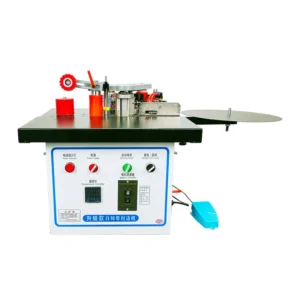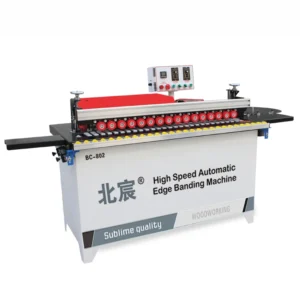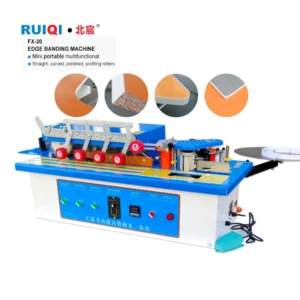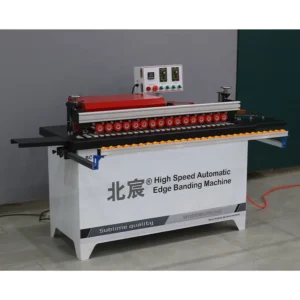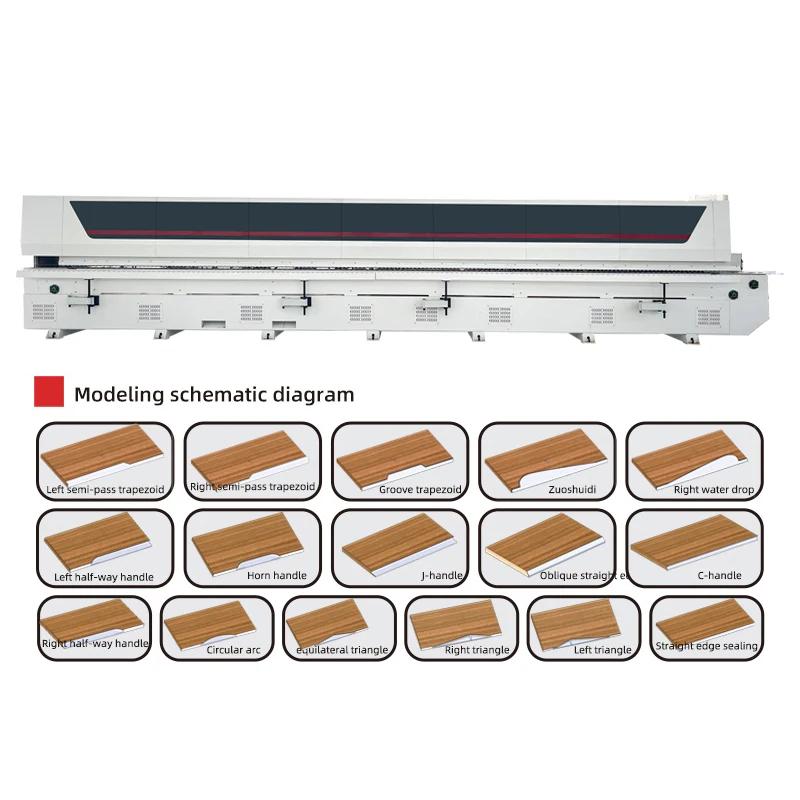
DW985 Soft Forming Edge Banding Machine, 16 Functions, 8-12 m/min Feed Speed, 380V — engineered as a throughput-matched station within full furniture production lines, aligning cycle times between upstream panel saws and downstream boring equipment. - 16 integrated process stations from pre-milling through soft forming to final polish - Servo-driven milling (0.75KW×3) for consistent profiling accuracy - Touch screen control with remote upgrade for batch profile switching - Line layout and throughput matching provided by application engineers -0.2亿
16-Station Line Integration — The DW985 is configured to match throughput with upstream saws and downstream boring stations, preventing bottlenecks in a complete furniture production layout.
| Parameter | Value |
|---|---|
| Model | DW985 |
| Product Type | Soft Forming Edge Banding Machine |
| Function Count | 16 Functions |
| Feed Speed | 8–12 m/min (basis not stated in source — confirm panel material / thickness / edge banding type) |
| Voltage | 380V (frequency to be confirmed) |
| Control System | Touch screen operation with remote upgrade capability |
| Semi-J Rough Milling Motor | 5 kW |
| Inclined Straight Edge Pre-milling Motor | 5 kW |
| Semi-J Finish Milling Motor | 6 kW × 2 |
| Milling Servo Drive | 0.75 kW × 3 |
| Slab Chamfering & Edge Banding Breaking Motor | 0.55 kW × 2 |
| Edge Banding & Slotting Motor | 0.3 kW |
| End to End Motor | 0.37 kW × 2 |
| Coarse & Fine Finishing Department Motor | 0.75 kW × 2 |
| Plate Polishing Motor | 0.37 kW × 2 |
| Plate Conveying Motor | 5.5 kW |
| Pressure Beam Lifting Motor | 0.37 kW |
| Gross Mass | 4.2 t (source value — verify against manufacturer catalog) |
| Machine Size | 950 × 98 × 184 cm (source value — verify against manufacturer catalog) |
| Process Stations | Separate → Linear Pre-milling → Milling → Rough Mill → Inclined Straight Pre-milling → Finish Milling → Finishing Milling 2 → Handle-free Chamfer → Plate Heating → Wash → Edge Banding and Slotting → Rubber Coating → Heating System → Soft Forming and Pressing → Edge Banding Breaking → End to End → Rough Repair → Truing → Edge Scraping → Copying Chamfer → Wash → Polish |
| Language Options | Chinese, English (other languages customizable) |
| Plug Options | EU, USA, AU, UK |
| Assembly State | Fully assembled |
| Standards | CE, ISO 9001 |
| Application | Material or Output |
|---|---|
| Cupboard panel edge banding | MDF and particleboard with PVC or veneer edge banding |
| Custom furniture production lines | Plywood and solid wood panels requiring soft forming profiles |
| Cabinet door soft forming | Veneer banding on shaped edges for handle-free designs |
| Wardrobe and storage unit panels | Particleboard and MDF with standard straight edge profiles |
| Turnkey factory panel processing | Mixed substrate batches across a full cutting-to-assembly line |
A soft forming edge banding machine production line only works when every station keeps the same rhythm.
I once configured a panel line for a cabinet factory where the beam saw was cutting at full capacity, the boring station was ready, but the edge bander could not keep up with the feed volume. Panels stacked on the conveyor, operators stood idle, and the factory lost three days before I arrived on site to recalibrate the feed parameters. The soft forming edge banding machine production line was rated well on paper, but the actual throughput at that station did not align with the saw output. When you evaluate this DW985, the 8–12 m/min feed speed range needs to be checked against your upstream panel saw cycle time and downstream boring or CNC station throughput. [NEED_CITE: line balancing principles in panel furniture manufacturing]
A soft forming edge banding machine production line is only as fast as its slowest station. The DW985 runs at 8–12 m/min, which typically aligns with mid-volume panel saw outputs and multi-boring machine cycles in a furniture factory setting. Before we configure a line, we calculate the panel flow rate at each station — cutting, edge banding, boring, and assembly — so no single machine becomes the constraint. This matching process prevents the conveyor pile-ups that shut down production.
The 16 integrated process stations on the DW985 handle the full edge treatment sequence from pre-milling through soft forming and pressing to final polishing. In a production line context, this means panels enter from the saw station and exit ready for boring or assembly without needing a secondary edge finishing pass. The touch screen control allows operators to switch profiles between batches, and the remote upgrade capability means new profile shapes can be loaded without an on-site visit. [NEED_CITE: soft forming veneer adhesion requirements across substrate types]
The three servo-driven milling drives at 0.75 kW each maintain profiling consistency when panel thickness varies across a production batch — a common situation when a factory runs both 18 mm particleboard shelving and 25 mm MDF cabinet doors on the same line. The 5.5 kW plate conveying motor provides steady feed force across the 9.5-meter machine length, preventing slippage that causes edge misalignment. Pre-milling stations with 5 kW motors ensure the panel edge is square before banding, which directly affects downstream assembly fit. The gross mass of 4.2 t gives the machine the rigidity needed to hold tolerance under continuous line operation, though this value should be verified against the final manufacturing specification before ordering.
Buying an edge bander as a standalone unit and dropping it into an existing line often creates a mismatch in feed height, conveyor speed, or panel spacing. I have seen factories where the edge bander could physically accept panels from the saw, but the conveyor transfer height was off by a few centimeters, causing panels to catch and jam at the infeed. [NEED_CITE: conveyor transfer height tolerances in panel processing lines] Operators end up manually guiding boards into the machine, which defeats the purpose of a continuous line and introduces edge damage that shows up as visible glue lines on finished panels.
The DW985 supports a production line approach in stages. A factory starting with a panel saw and this edge bander can add boring machines and CNC stations later without replacing the bander, because the feed speed range and panel thickness capacity accommodate growth in line volume. The voltage is configurable and the control panel language is selectable, so the same machine model works across different export markets without modification. [NEED_CITE: phased capital investment planning for panel furniture factories]
The machine is manufactured in a 10,000 square meter facility with a four-stage QC process covering incoming material inspection, in-process checks, finished product verification, and pre-shipment testing. Engineer-led configuration is provided within 24 hours of inquiry, including a line layout proposal that maps throughput between this edge bander and adjacent stations. Proprietary cutting mechanism patents support the ±0.02 mm tolerance claim, and factory visits are welcomed so buyers can run their own panel material through the machine before committing to an order.
To prepare a line layout that integrates the DW985 with your existing or planned equipment, provide your upstream panel saw model and its cycle time, the types and thicknesses of board you run most frequently, and the edge banding materials you stock. Confirm your facility voltage and frequency, the available floor length for the edge banding station including conveyor approach and exit space, and whether you need the control panel in a language beyond Chinese or English. If you want a pre-shipment test on your actual panel stock, arrange to send sample material or schedule a factory visit.
Q: How is feed speed matched to upstream panel saws and downstream boring machines in a full line?
A: We calculate the panel flow rate at each station based on your saw cycle time, average panel dimensions, and boring machine throughput. The DW985 feed speed is then set within its 8–12 m/min range to match that flow, and conveyor transfer heights are aligned so panels move between stations without manual intervention or catching.
Q: What is the phased investment approach for building a complete edge banding and assembly line?
A: Many factories start with a panel saw and the DW985 edge bander, then add boring machines and CNC routers as volume grows. Because the DW985 feed speed range and panel thickness capacity cover a broad production scope, it does not need replacing when the line expands — only the upstream and downstream stations are added.
Q: How is the line layout planned around factory floor space and material flow?
A: We work from your facility floor plan to position each station so panels flow in one direction with minimal cross-traffic. The DW985 at roughly 9.5 meters long needs infeed and outfeed conveyor space on each side, and we account for operator access paths and maintenance clearance around the full machine perimeter.
Q: Can the DW985 be integrated with existing equipment from other suppliers in my current line?
A: Yes, provided the conveyor transfer heights match and the feed speed of the existing saw and boring machines falls within a compatible range. We review your current equipment specifications and adjust the DW985 infeed and outfeed conveyor configuration to bridge any gap between stations.
Q: What throughput can be verified during a factory visit with my actual panel material?
A: During a visit, we run your specific panel thickness, substrate type, and edge banding stock through the DW985 and record the feed speed, edge quality, and cycle time. This gives you a verified throughput figure based on your actual material rather than a generic rating.
* Detailed technical specifications vary by model. Contact us for the full parameter sheet and customization options.
Heavy-duty wooden crate with moisture-proof lining and steel strapping. Seaworthy standard for safe ocean freight.
Standard models: 15-20 working days. Custom OEM orders: 25-35 working days from deposit confirmation.
FOB Qingdao / Tianjin. EXW, CIF available. T/T, L/C, Western Union accepted. Flexible payment terms for long-term partners.
We export to 100+ countries across Europe (Germany, Spain, Italy), Americas (USA, Mexico, Brazil, Argentina), Southeast Asia (Vietnam, Indonesia, Thailand), Africa (Nigeria, Egypt, South Africa), and the Middle East. Full customs documentation and export compliance support included.
Your logo on machine body, control panel and packaging. Full white-label production available.
Support 110V/60Hz, 220V/50Hz, 380V/50Hz, 440V/60Hz and other local electrical standards.
Modify table size, motor power, cutting capacity and other parameters per your production requirements.
Control panel available in English, Spanish, French, Arabic, Russian and other languages on request.
Custom paint color, machine casing design and aesthetic modifications to match your brand identity.
Bundled tooling sets, spare parts kits, installation tools and custom accessories for your market needs.
Fill in your requirements and our sales team will respond within 24 hours with a formal quotation and full technical specifications.