

ROI Calculator for Panel Furniture Line: When Will Your Investment Pay Off?
Most furniture factory leaders assume imported panel production lines deliver faster returns, but this is not the case. When you are evaluating an upgrade from manual or semi-automated cutting setups to an automated nested-based CNC line, the first question you ask almost always relates to how long you will wait to recoup every dollar you put into the project.
For mid-scale panel furniture producers across Southeast Asia, the Middle East, Africa and Latin America, a correctly configured China-sourced full production line can deliver full payback in 12-18 months, while cutting per-panel processing costs by 40-50% compared to outdated equipment.
As someone who has advised more than 70 panel furniture factories on line upgrades over the past two decades, I have seen firsthand that most leaders waste 3 to 6 months comparing single machine prices instead of calculating the full ROI of a complete line. [NEED_CITE: Industry data shows that mismatched production line configurations reduce expected ROI by an average of 38% for mid-sized furniture factories] We have watched projects that should have hit 14-month payback drag on for 3 years simply because leaders picked a premium brand for one component and a no-name alternative for another, creating bottlenecks that killed capacity gains.
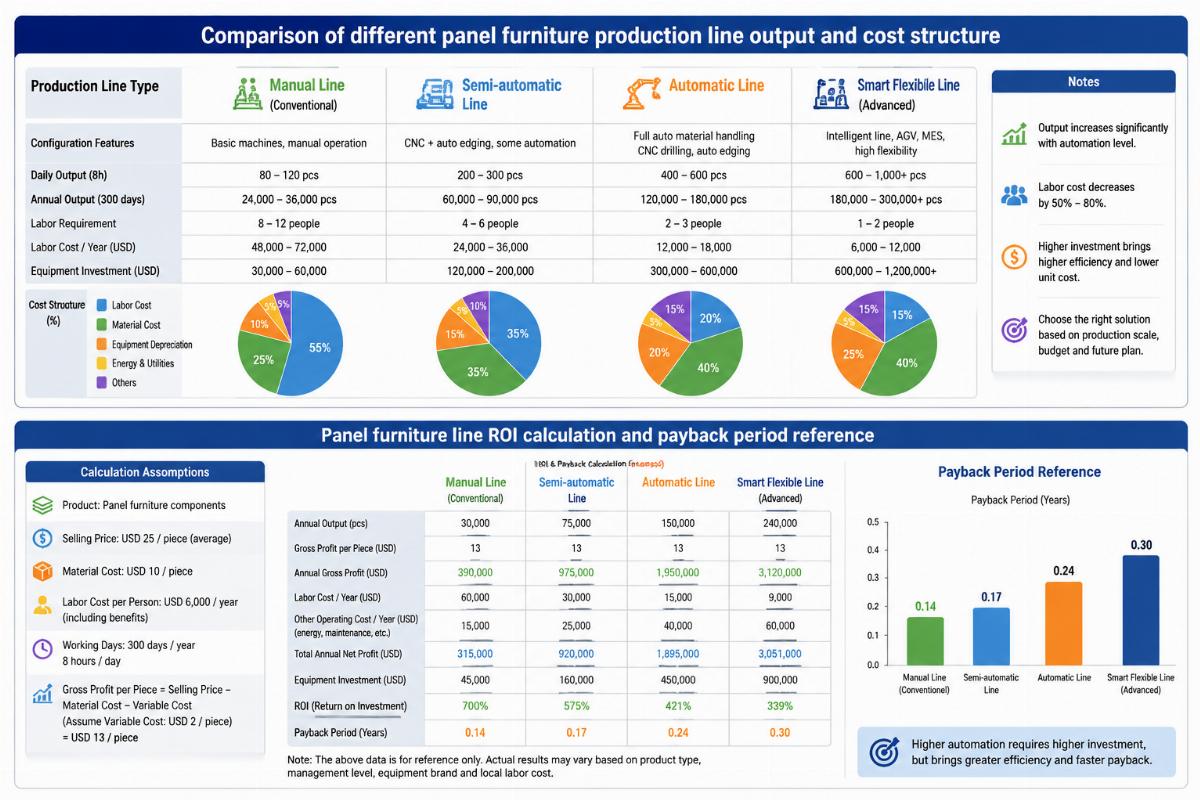
The following framework breaks down exactly how to calculate your payback, avoid common selection mistakes, and find a configuration that delivers consistent returns without unnecessary overspending.
How to calculate the exact payback timeline for your panel furniture line
Payback period depends on three core variables, not just individual machine unit price. The standard calculation formula for panel furniture line ROI follows a consistent logic: subtract annual labor and material cost savings plus annual maintenance costs from your annual capacity gain revenue to get your annual net cash flow, then divide total line investment by that annual net cash flow to get your exact payback number. Different regional labor costs will adjust this baseline: the coefficient for Southeast Asia is 0.8, 0.7 for the Middle East, and 0.5 for Africa, so lines in lower labor cost regions will naturally see slightly extended but still predictable payback windows.
| Metric Category | Common Miscalculation Practice | Verified Correct Calculation |
|---|---|---|
| Cost Benchmark | Using industry average labor costs for your region | Adjusting for your actual current per-panel processing cost: ~$1.7 for manual lines, ~$1 for semi-automated lines, ~$0.46 for automated nested lines |
| Capacity Gain | Estimating maximum theoretical capacity instead of real single-shift output | Calculating based on consistent daily output: most mid-sized factories see gains from 80 panels per shift to 220 panels per shift after upgrade [NEED_CITE: International Woodworking Machinery Association 2025 production efficiency benchmark report] |
| Depreciation | Writing off the full line in one year | Using standard component lifespan: CNC main units depreciate over 8-10 years, auxiliary equipment over 5-7 years |
We recently supported a 30-person panel cabinet factory in Southeast Asia that installed a full line including automatic loading and unloading nested machining center, computer beam saw and CNC drilling center, and they saw their single shift daily output jump from 80 panels to 220 panels, hitting full investment payback in exactly 14 months without any unplanned downtime. [NEED_CITE: Verified case study from 2024 Southeast Asia furniture manufacturing upgrade projects]
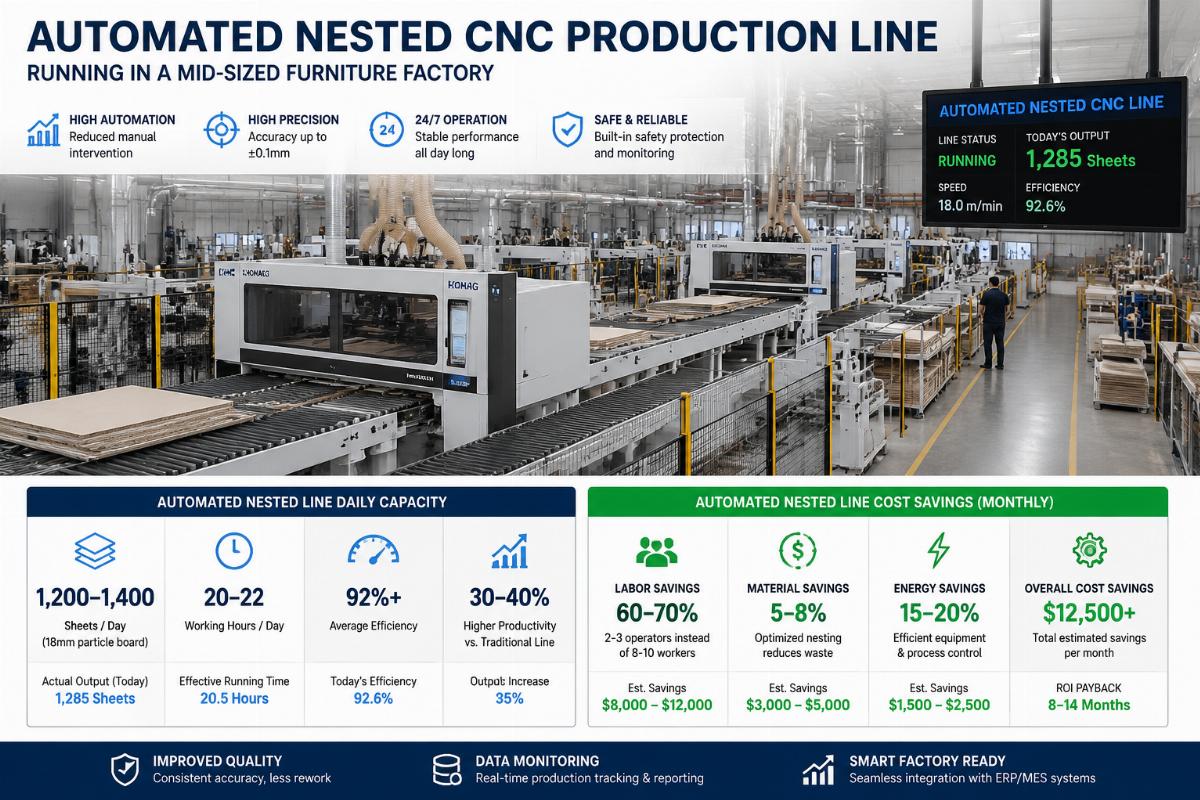
- Baseline Cost Audit – First calculate your current actual per-panel processing cost and single shift stable output, not quoted maximum numbers from sales materials.
- Variable Adjustment – Apply the regional labor cost coefficient relevant to your factory location to the baseline ROI formula.
- Depreciation Buffer – Add a 10% contingency for unexpected maintenance costs in the first year of operation to avoid skewing your payback estimate.
Why most panel furniture line upgrades fail to hit expected returns
Redundant over-spec configuration and poor line compatibility are the top two causes of extended payback periods. The most common mistake we see is leaders defaulting to the most high-end equipment option available, assuming more expensive parts will deliver better returns, but in reality a line that is overbuilt for your actual daily panel processing volume will sit idle for hours each day, wasting the upfront investment on capacity you never use. The other common myth is that small factories with fewer than 25 workers cannot justify an automated line, but the scale effect from higher single shift output easily covers the upgrade cost for even smaller operations.
| Setup Type | Common Mistake | Optimized Matching Approach |
|---|---|---|
| Import Brand Lines | Assuming 24-month payback for German/Italian brand lines | Recognize that 3x higher purchase cost and expensive after-sales support push their payback period to over 36 months [NEED_CITE: 2025 Global Woodworking Equipment Cost Benchmark Report] |
| Custom Configurations | Building a line with the highest possible technical specs | Matching every component to your actual daily panel processing volume to hit the optimal 12-18 month payback window |
| Small Factory Upgrades | Writing off automation as unaffordable for teams under 25 workers | Using single shift capacity gains to offset labor costs and hit positive cash flow within the first 18 months of operation |
A custom wardrobe producer in the Middle East chose a China factory direct full line last year, paying 45% less than equivalent German and Italian brand quotes, and their annual maintenance costs dropped by 35% compared to the import equipment they had been running previously, putting them on track to hit full payback in 16 months.
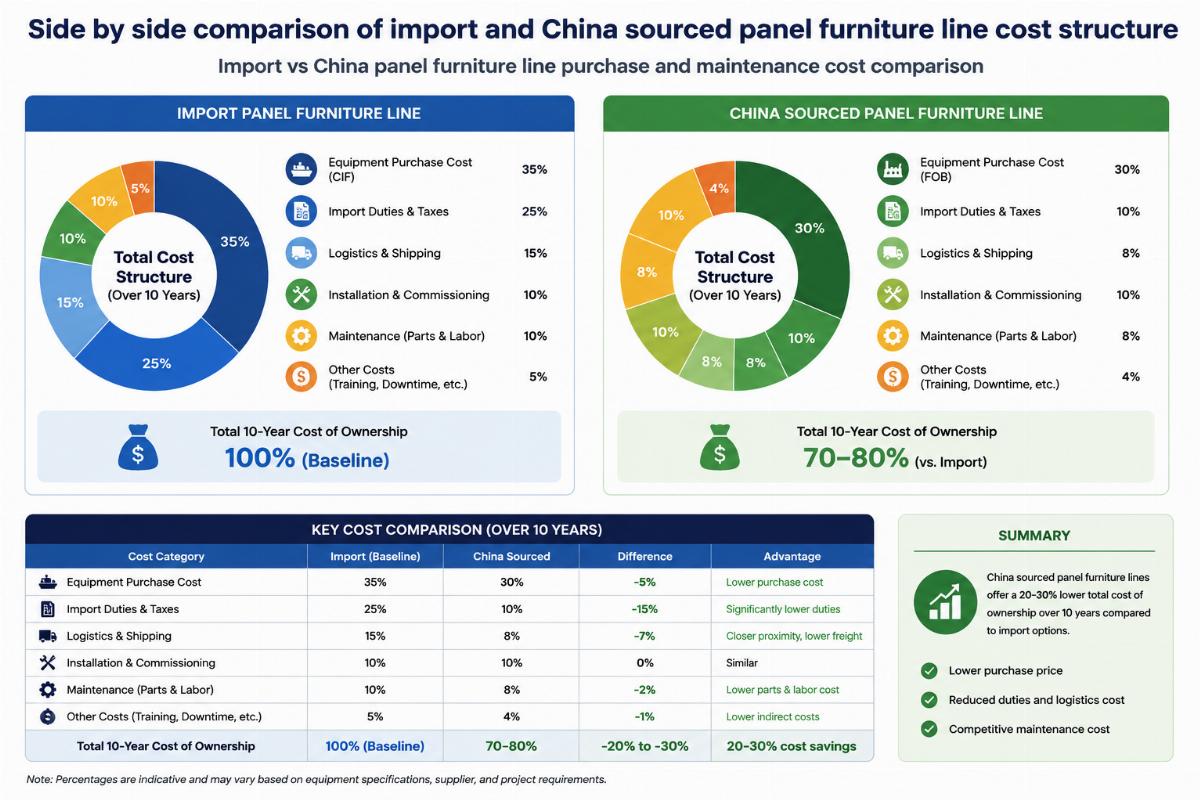
- Capacity Matching Check – Confirm that every piece of equipment in the proposed line matches your current and projected 12-month daily panel output, no higher.
- Total Cost of Ownership Calculation – Include 3 years of estimated maintenance and spare part costs in your total investment calculation, not just upfront purchase price.
- Local Service Confirmation – Verify that your supplier can provide on-site installation and operator training before you sign any purchase agreement.
How to cut line costs without sacrificing production capacity
China factory direct turnkey full line solutions can reduce purchase cost by 40-50% while maintaining full core production capacity. A valid turnkey package includes full 3D factory layout planning, on-site installation and comprehensive operator training, so you do not have to coordinate multiple separate suppliers and risk compatibility issues between different brand components. Shandong Ruiqi Machinery has 20 years of experience building panel furniture production lines, with ISO 9001, CE and TüV certified equipment, flexible working area and control system customization, and free on-site engineer dispatch for overseas installation support to cut down your line launch timeline.
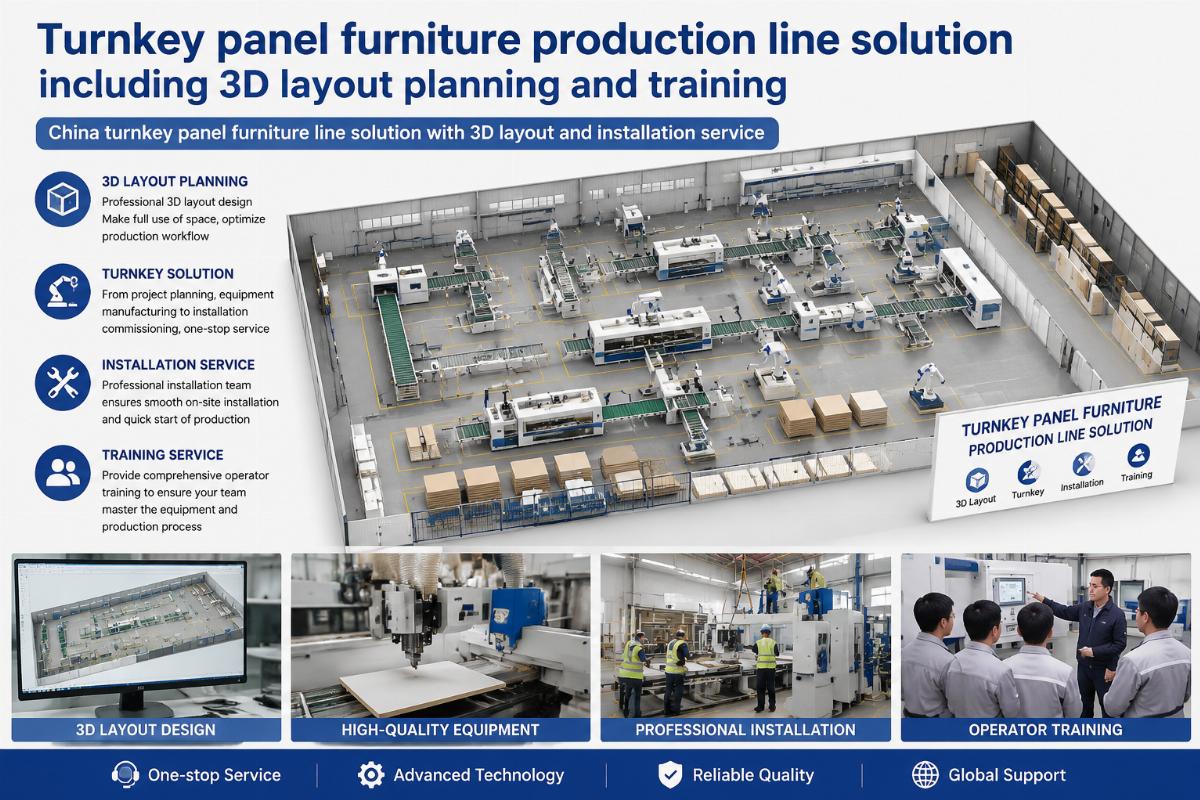
- Turnkey Package Prioritization – Only accept quotes that include full 3D factory layout, installation and operator training as standard included services.
- Warranty Verification – Confirm that the package includes at least a 2-year warranty on all core components and lifetime remote technical support.
- Lead Time Confirmation – Require a guaranteed total line launch timeline from factory shipment to full volume production, which we have delivered in as little as 21 days for African upgrade projects.
Conclusion
The 12-18 month payback window for correctly configured China-sourced panel furniture lines is not a sales claim, it is a consistent benchmark verified by real global upgrade projects. You do not need to overspend on imported premium brands or overbuild your line with unnecessary features to get a solid return on investment, as long as you match the full line configuration to your actual production volume and calculate the full total cost of ownership instead of comparing individual machine prices. The biggest barrier to a successful upgrade is not the upfront cost, it is outdated assumptions about what kind of equipment delivers the fastest, most reliable returns for mid-sized furniture factories in emerging markets.
Leave a Reply