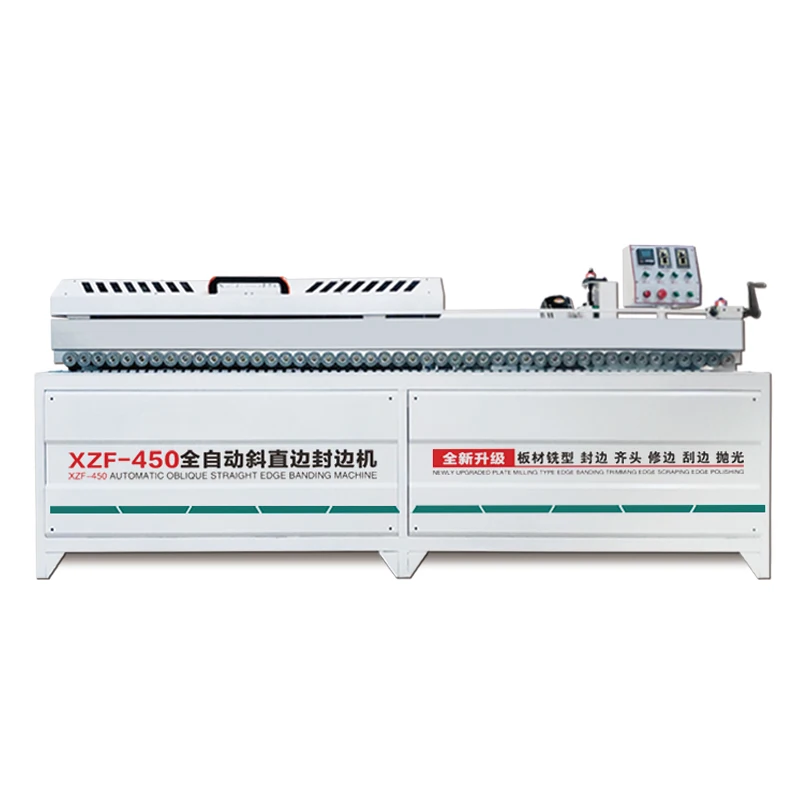
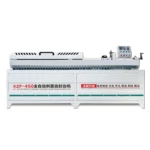
XZF-450 Edge Banding Machine, 9.5KW, 0-12M/min Feed Speed, 0.3-3MM Banding Thickness — integrates pre-milling, 30°/45°/60° edge banding, trimming, scraping, and polishing into one station for full-line furniture production. Feed speed synchronizes with upstream panel saws and downstream boring stations to match throughput across the line. - 4KW pre-milling motor ensures clean substrate preparation - 550W vacuum system maintains dust control between stations - Voltage and frequency must be confirmed against factory infrastructure before order. - Engineer-led configuration recommendation with formal quotation within 24 hours, four-stage QC with pre-shipment verification, and after-sales support coverage for target installation country.
Production-Ready Line Integration — the XZF-450 is configured to match upstream cutting and downstream boring station cycle times before it leaves the factory, so your edge banding machine production line does not bottleneck at one station.
| Parameter | Value |
|---|---|
| Model | XZF-450 |
| Product Type | Edge Banding Machine |
| Total Power | 9.5 kW |
| Voltage & Frequency | 380V/415V (frequency to be confirmed: 50Hz or 60Hz) |
| Feed Speed | 0–12 m/min |
| Overall Dimensions (L×W×H) | 300 × 65 × 135 cm |
| Net Weight | 430 kg |
| Edge Banding Thickness | 0.3–3 mm |
| Edge Banding Height | 0–50 mm |
| Minimum Sheet Length | 30 cm |
| Minimum Sheet Width | 15 cm |
| Pre-milling Motor Power | 4 kW |
| Trimming Power | 2.2 kW × 2 |
| Polishing Power | 0.4 kW × 2 |
| Edge Feeding Power | 0.16 kW |
| Transmission Power | 180 W |
| Vacuum Power | 550 W |
| Glue Pot Capacity | 4000 ml |
| Air Source Pressure | 0.5–0.7 MPa |
| Standard Functions | Pre-milling, 30°/45°/60° edge banding, trimming, scraping, polishing, high-power vacuuming |
| Language Options | Chinese and English standard; Spanish and other languages customizable |
| Plug Options | EU, USA, AU, UK |
| Application | Material or Output |
|---|---|
| Straight and beveled edge banding for cabinet doors | MDF, melamine-faced board, plywood |
| 45-degree profile edges for custom furniture | Solid wood board, blockboard |
| Panel edge finishing in a full production line | Particleboard, polymer door panels |
| Medium-to-large batch cabinet manufacturing | PVC and veneer edge banding materials |
Throughput mismatch is the most expensive mistake in panel processing layout. I once watched a custom cabinet factory in the Yangtze Delta run their CNC nesting and multi-boring stations on automatic feed, only to have the edge banding station fall behind because it was specified as a standalone unit without checking line-wide cycle time. Panels stacked three-high on roller conveyors waiting for the bander, while upstream machines idled.
The root cause is almost always the same: the buyer sourced machines individually over several months, each with its own feed speed, working height, and control logic, then expected them to flow together. By the time the bottleneck surfaced, the factory had already committed to a layout that could not be rearranged without rewiring and re-piping [NEED_CITE: material flow and station synchronization in panel processing lines].
The XZF-450 offers a variable feed speed from 0 to 12 m/min, which is the range most mid-volume furniture lines operate within. The critical step is not the maximum speed but the sustained speed that your upstream panel saw and downstream boring machine can both support. If the CNC router discharges panels at a rate that demands 9 m/min at the bander, running at 11 m/min creates gaps, while running at 7 m/min queues inventory between stations.
An edge banding machine production line requires enough floor space between stations for short-term panel buffering without blocking the feed path. The XZF-450’s 300 cm footprint length determines the minimum conveyor run from the cutting station to the bander infeed. Factor in the 15 cm minimum sheet width when designing guide rails, since narrow offcuts from a panel saw need stable tracking through the pre-milling and banding heads.
The 9.5 kW total power draw means this station needs a dedicated circuit separate from high-draw CNC routers, especially on 380V/415V three-phase supply [NEED_CITE: voltage and frequency standards by export market]. The 0.5–0.7 MPa air supply requirement is typical for pneumatic trimming and scraping actuators, but confirm your compressor capacity covers all stations running simultaneously. The 4000 ml glue pot holds enough adhesive for sustained production without frequent refills, reducing unplanned stops mid-run.
The pre-milling station at 4 kW is sized to handle standard MDF and melamine-faced board without bogging down at higher feed rates, which matters when you are trying to keep pace with a high-output panel saw upstream.
The most common failure I have seen in coordinated lines is height mismatch. If the upstream conveyor delivers panels at 900 mm and the edge bander infeed table sits at 850 mm, operators manually lift every sheet, introducing fatigue and inconsistency. A second issue is air pressure starvation: when three or four pneumatic stations share an undersized compressor, trimming and scraping quality drops without an obvious alarm [NEED_CITE: pneumatic system sizing for multi-station woodworking lines].
The XZF-450 carries pre-milling, multi-angle banding, trimming, scraping, and polishing in a single frame, so a factory can install it as the edge banding station today and add upstream or downstream equipment later without replacing the bander. The 30°/45°/60° capability means one station handles both straight carcass edges and beveled door profiles, reducing the need for a second dedicated machine. Its 430 kg weight provides enough mass to damp vibration during heavy pre-milling passes without requiring a poured foundation pad.
Share your upstream cutting machine model and its discharge rate so the engineer can calculate the sustained feed speed the XZF-450 needs to match. Provide your factory voltage and frequency, workshop floor plan with available station spacing, and the panel materials and edge profiles you run most often. If you are phasing the line investment, specify which stations are already on-site and which are planned for later stages.
Q: How does the XZF-450 feed speed synchronize with upstream panel saws and downstream boring machines in a full line?
A: The 0–12 m/min variable feed is set during commissioning to match the actual discharge rate of your cutting station and the intake cycle of your boring machine. The engineer calculates the sustained speed based on your daily panel volume and adjusts the transmission rate so panels flow continuously without queuing or starving downstream stations.
Q: What is the phased investment approach when building a complete edge banding machine production line around this machine?
A: You can install the XZF-450 as your first automated station and add upstream cutting or downstream boring equipment in later phases. The machine’s standard working height and feed direction are compatible with typical roller conveyor heights, so future stations plug into the same material flow path without repositioning the bander.
Q: How do I confirm voltage, frequency, and air supply requirements match my factory’s existing utility infrastructure?
A: Provide your local supply voltage, phase configuration, and frequency before order confirmation. The electrical schematic is prepared to your spec, and the pneumatic circuit is tested at the required 0.5–0.7 MPa range. If your compressor serves multiple stations, the engineer will confirm adequate flow capacity for simultaneous operation.
Q: What line layout and material flow considerations should I plan for before ordering this edge bander as part of a turnkey project?
A: Reserve sufficient conveyor length between the upstream saw and the XZF-450 infeed for short-term panel buffering. Account for the 300 cm machine length plus operator clearance on both sides. Confirm that narrow panels down to 15 cm width will track through guide rails without jamming at station transitions.
Q: How is pre-shipment testing conducted to verify the machine will integrate with the rest of the production line upon arrival?
A: The factory runs your specified panel material and edge banding stock through all stations, recording feed speed, trimming quality, and polishing finish. Test records and photographs are shared before crating, so you can verify line-ready performance against your production requirements before the machine ships.
* Detailed technical specifications vary by model. Contact us for the full parameter sheet and customization options.
Heavy-duty wooden crate with moisture-proof lining and steel strapping. Seaworthy standard for safe ocean freight.
Standard models: 15-20 working days. Custom OEM orders: 25-35 working days from deposit confirmation.
FOB Qingdao / Tianjin. EXW, CIF available. T/T, L/C, Western Union accepted. Flexible payment terms for long-term partners.
We export to 100+ countries across Europe (Germany, Spain, Italy), Americas (USA, Mexico, Brazil, Argentina), Southeast Asia (Vietnam, Indonesia, Thailand), Africa (Nigeria, Egypt, South Africa), and the Middle East. Full customs documentation and export compliance support included.
Your logo on machine body, control panel and packaging. Full white-label production available.
Support 110V/60Hz, 220V/50Hz, 380V/50Hz, 440V/60Hz and other local electrical standards.
Modify table size, motor power, cutting capacity and other parameters per your production requirements.
Control panel available in English, Spanish, French, Arabic, Russian and other languages on request.
Custom paint color, machine casing design and aesthetic modifications to match your brand identity.
Bundled tooling sets, spare parts kits, installation tools and custom accessories for your market needs.
Fill in your requirements and our sales team will respond within 24 hours with a formal quotation and full technical specifications.