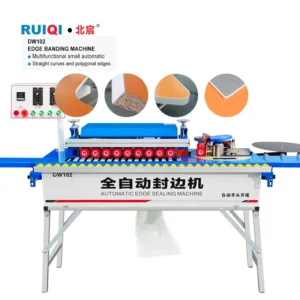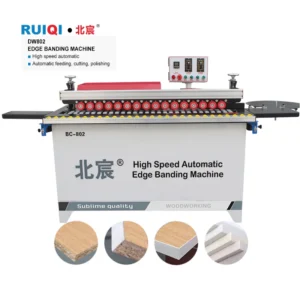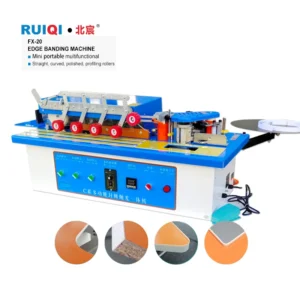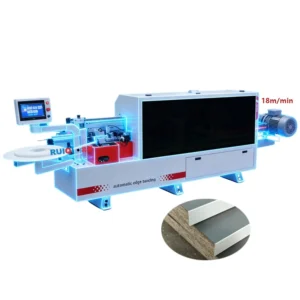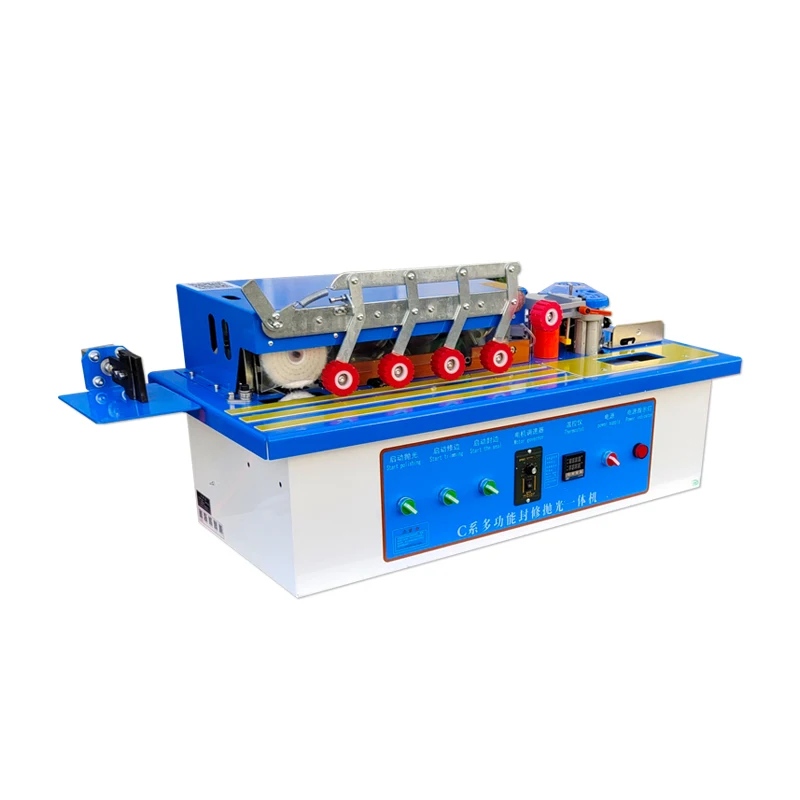
Portable Curved and Straight Edge Banding Machine, 2500W, 0.3–3mm Edge Thickness, 0–50mm Banding Height — handles MDF, particleboard and plywood in compact workshop layouts.
Engineer-led line-layout proposals confirm throughput matching with upstream saws and downstream borers before you commit.
Compact line integration — This portable edge banding machine supports phased production line layouts with verified upstream and downstream throughput matching before commitment.
| Parameter | Value |
|---|---|
| Product Type | Edge Banding Machine |
| Total Power | 2500W |
| Voltage & Frequency | 220V/380V (50Hz/60Hz to be confirmed) |
| Edge Banding Height | 0–50mm |
| Edge Banding Thickness | 0.3–3mm |
| Minimum Sheet Length | 25cm |
| Minimum Sheet Width | 10cm |
| Glue Pot Capacity | 1000ml |
| Air Source Pressure | 0.5–0.8 MPa |
| Overall Dimensions (L×W×H) | 100×46×41cm |
| Net Weight | 44kg |
| Standard Functions | Curved/straight banding, trimming, polishing, manual push plate |
| Control Interface | Operation panel (PLC/CNC status to be confirmed) |
| Language Options | Chinese and English standard; other languages customizable |
| Plug Options | EU, USA, AU, UK |
| Application | Material or Output |
|---|---|
| Small-scale custom cabinet production | MDF and particleboard panels for kitchen and wardrobe carcasses |
| Curved-edge furniture components | Plywood and solid wood boards requiring radius edge sealing |
| Startup workshop phased line setup | Ecological board and plywood for entry-level furniture output |
| Home decoration and site joinery | Solid wood panels and MDF for on-site trim and shelving |
Mismatched infeed and outfeed heights between stations cause more line stoppages than any single machine fault.
I learned this the hard way when a cabinet factory in Shandong commissioned a new line. The panel saw and edge bander were sourced separately, and the transfer height differed by just over a centimeter. Panels caught on the edge bander’s infeed rail, scratching surfaces and forcing operators to manually lift each board across the gap. That small oversight shut the line down repeatedly during the first week. When planning an edge banding machine production line, verifying station-to-station geometry before equipment arrives on site prevents these costly integration failures [NEED_CITE: common material handling issues in panel processing lines].
When a workshop begins building its first furniture production sequence, floor space is limited and capital must be allocated across multiple stations. The FX-20 occupies roughly one square meter of floor area, leaving room for a sliding table saw upstream and a multi-boring machine downstream. This compact footprint means the edge banding machine production line can start with a manual-push workflow and expand later without relocating the entire workshop layout.
A common mistake in early-stage line design is pairing a high-speed panel saw with a manually fed edge bander, creating a bottleneck where cut panels pile up faster than they can be banded. The FX-20 requires an operator to push each panel through, so upstream cutting rates must be paced accordingly. When we plan an edge banding machine production line around this unit, we calculate the realistic cycle time per panel — including manual loading, trimming, and polishing — then match the saw output to that rhythm. Balanced throughput prevents work-in-progress accumulation and keeps material flow steady [NEED_CITE: principles of line balancing in woodworking production].
The 0–50mm edge banding height range covers standard 16mm, 18mm, and 25mm panel thicknesses used in cabinet and furniture construction, along with thicker solid wood components up to 50mm. This range determines which panel types can pass through this station without requiring a separate machine for oversized stock. The 0.3–3mm banding thickness capability handles both thin PVC for cost-effective carcass edges and thicker veneer or ABS strips for visible furniture faces. The 2500W total power draw across the glue pot, trimming motors, and polishing units means this station can share a standard workshop circuit without requiring a dedicated high-capacity breaker — a practical consideration when distributing electrical load across a developing production line. The 0.5–0.8 MPa air pressure requirement aligns with typical workshop compressor output, so the same air supply serving a panel saw’s clamp or a boring machine’s cylinders can feed this edge bander without adding a second compressor.
Buying machines one at a time without a unified line plan leads to compounding problems. I have visited workshops where three different voltage specifications existed across four machines because each was ordered without checking the others. One edge bander ran on 220V single-phase while the panel saw required 380V three-phase, forcing the factory to install an additional transformer mid-production. Control panels arrived in a language the operators could not read, delaying commissioning by days while translated overlays were sourced. These issues are avoidable when every station in the edge banding machine production line is specified together, with voltage, frequency, and interface language confirmed against the facility’s actual infrastructure before any order is placed [NEED_CITE: electrical compatibility requirements for imported industrial machinery].
Every machine on this line is specified against your facility’s confirmed voltage and frequency, so a 220V/50Hz workshop receives every station wired to that standard — no transformers needed on arrival. The four-stage quality control process includes a pre-shipment test where panels from your actual material range are run through the edge bander to verify banding adhesion, trimming accuracy, and surface finish before the crate is sealed. Engineer-led configuration proposals address station-to-station feed height, air supply sizing, and electrical load distribution across the complete line. Factory visits allow you to see the FX-20 running alongside comparable saws and boring machines in a simulated line arrangement. Custom control panel language ensures operators at every station read instructions in their working language, eliminating guesswork during commissioning.
When you are ready to specify this edge bander within a broader production layout, provide your panel material types and thicknesses, the upstream saw model and its cut rate, and your facility’s confirmed voltage and air supply capacity. If you are planning curved-edge and straight-edge work on the same line, note the volume split between the two so we can advise whether this single unit covers both or a dedicated straight-line bander should follow in the next investment phase.
Q: How does this edge bander’s throughput match with upstream panel saws and downstream boring machines?
A: The FX-20 uses manual push feed, so throughput depends on operator pace and panel size. When we plan an edge banding machine production line around it, we calculate realistic cycle times per panel and recommend upstream saw settings that prevent material pile-up at the banding station while keeping downstream borers supplied.
Q: What is the phased investment path from this portable unit to a full-auto inline edge banding line?
A: Start with the FX-20 for low-volume curved and straight work, then add a dedicated high-speed straight-line bander as volume grows. The FX-20 then shifts to handling curved-edge orders and small batches, retaining its role in the expanded line without becoming redundant.
Q: How do I confirm voltage, frequency, and air supply compatibility across all stations?
A: Provide your facility’s electrical specification and compressor capacity at the inquiry stage. We confirm every station — saw, bander, borer — against those values before production, so all machines arrive wired and plumbed to match your existing infrastructure without adapters or transformers.
Q: Can the FX-20 handle both curved and straight edges in one line setup?
A: Yes. The FX-20 performs curved and straight edge banding plus trimming and polishing in a single compact station. This eliminates the need for two separate machines during early-stage line investment, freeing floor space and budget for other stations like boring or slotting equipment.
* Detailed technical specifications vary by model. Contact us for the full parameter sheet and customization options.
Heavy-duty wooden crate with moisture-proof lining and steel strapping. Seaworthy standard for safe ocean freight.
Standard models: 15-20 working days. Custom OEM orders: 25-35 working days from deposit confirmation.
FOB Qingdao / Tianjin. EXW, CIF available. T/T, L/C, Western Union accepted. Flexible payment terms for long-term partners.
We export to 100+ countries across Europe (Germany, Spain, Italy), Americas (USA, Mexico, Brazil, Argentina), Southeast Asia (Vietnam, Indonesia, Thailand), Africa (Nigeria, Egypt, South Africa), and the Middle East. Full customs documentation and export compliance support included.
Your logo on machine body, control panel and packaging. Full white-label production available.
Support 110V/60Hz, 220V/50Hz, 380V/50Hz, 440V/60Hz and other local electrical standards.
Modify table size, motor power, cutting capacity and other parameters per your production requirements.
Control panel available in English, Spanish, French, Arabic, Russian and other languages on request.
Custom paint color, machine casing design and aesthetic modifications to match your brand identity.
Bundled tooling sets, spare parts kits, installation tools and custom accessories for your market needs.
Fill in your requirements and our sales team will respond within 24 hours with a formal quotation and full technical specifications.