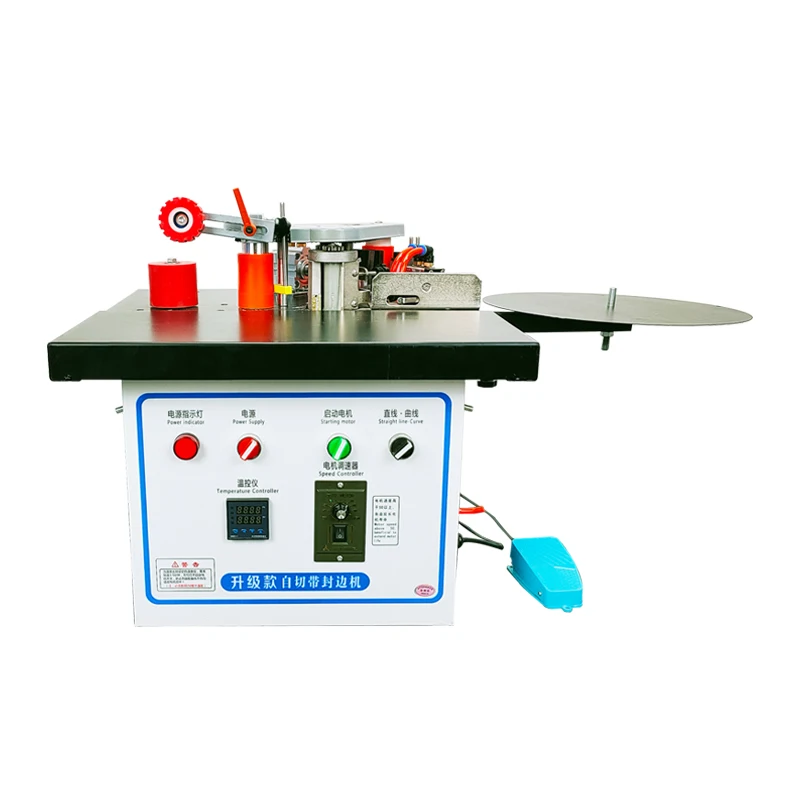
ST-50 Portable Edge Banding Machine, 1000W, 220V/380V, 0.3–3mm Banding Thickness — compact 50×50×47CM unit handling both curved and straight profiles on MDF, particleboard, plywood, and solid wood panels.
Engineer-led line configuration with formal quotation within 24 hours, four-stage QC with pre-shipment test records, and operation manual delivered in your operator's language.
Precision-Matched Auxiliary Station — a compact portable edge bander designed to slot into phased production line layouts without disrupting upstream feed heights or downstream throughput rhythms.
| Parameter | Value |
|---|---|
| Model | ST-50 |
| Product Type | Portable Edge Banding Machine |
| Total Power | 1000W |
| Voltage | 220V / 380V / customization |
| Edge Banding Height | 0–50mm |
| Edge Banding Thickness | 0.3–3mm |
| Minimum Sheet Length | 25cm |
| Minimum Sheet Width | 3cm |
| Edge Power | 20W |
| Air Source Pressure | 0.5–0.8 MPa |
| Glue Pot Capacity | 1000ml |
| Product Dimensions | 50 × 50 × 47cm |
| Net Weight | 22kg |
| Standard Features | Curved and straight edge banding |
| Control Panel Language | Chinese, English (customizable to Spanish or other languages) |
| Plug Options | EU, USA, AU, UK |
| Application | Material or Output |
|---|---|
| Furniture panel edge sealing | MDF, particleboard, plywood |
| Cabinet door and drawer front banding | Ecological board, melamine-faced chipboard |
| Curved profile edge finishing | Solid wood board, shaped plywood components |
| Small-batch rework and prototype runs | PVC and veneer edge banding materials |
| Home decoration and on-site repair | Laminated panels and blockboard |
A portable unit that does not match the roller table elevation of the panel saw upstream will jam every sheet that crosses over.
Last year I configured a line for a custom cabinet factory. The automatic edge bander they selected had a feed table sitting 12mm higher than the outfeed rollers on their sliding table saw. Panels caught on the lip every single pass, operators started hand-lifting boards across the gap, and within two days the line was shut down for bracket modifications. When planning an edge banding machine production line, the portable auxiliary stations are where these mismatches hide because nobody checks their table height against the main conveyor [NEED_CITE: mechanical integration standards for panel handling between woodworking stations]. The ST-50 sits at a fixed working height that should be verified against your existing roller tables before the unit is placed on the floor plan.
A turnkey edge banding solution does not always mean every station must be fully automatic from day one. The ST-50 occupies a specific niche within a phased line investment: it handles curved-profile work that a linear automatic edge bander cannot process, and it absorbs rework and sample runs so the main machine stays in continuous production. Positioning it as a side station near the cutting area lets operators pull reject panels for re-banding without pulling sheets off the primary conveyor. This keeps the edge banding machine production line moving while small corrections happen in parallel.
The ST-50 processes curved and straight edges on panels as narrow as 3cm and as short as 25cm — dimensions that would stall most inline automatic machines [NEED_CITE: minimum panel dimension requirements for automatic feed systems]. In a turnkey edge banding solution, this portable unit catches the jobs the main machine rejects: small offcuts that need edge sealing for shelf supports, curved drawer fronts that require manual feeding around the radius, and prototype pieces for client approval before the full batch runs. Throughput on a portable unit depends entirely on operator pace and edge complexity, so positioning it as a supplementary station rather than a primary production node keeps expectations realistic.
The 0–50mm edge banding height range covers standard 18mm chipboard and 25mm MDF used in cabinet carcasses, but it also reaches down to thin backing panels and up to thick worktop substrates. The 0.3–3mm banding thickness accepts both thin PVC for budget carcass work and thicker veneer strips for visible faces on premium furniture. The 1000ml glue pot capacity means operators will need to monitor refill intervals during sustained use — this is acceptable for an auxiliary station running intermittent batches but would be a constraint if the unit were mistakenly assigned as primary production equipment. Air pressure at 0.5–0.8 MPa must match your workshop compressor output; pressure drops below the lower threshold cause incomplete trimming and visible glue squeeze-out on the panel face.
Voltage mismatch is the quietest failure on a line. A 220V unit delivered to a facility running 380V three-phase at every other station will either sit idle or require a dedicated transformer — one more cable run, one more fault point. Language on the control panel matters equally: if the operator reads Spanish and the display defaults to Chinese, commissioning stalls until someone finds a translator. Across a multi-station edge banding machine production line, inconsistent voltage and panel languages multiply troubleshooting time at every station [NEED_CITE: operator interface language requirements under machinery safety directives]. Standardizing plug type, voltage, and display language at the quotation stage prevents weeks of delays during installation.
In-house manufacturing means the ST-50 can be ordered with the same voltage, plug type, and control panel language as the rest of your line equipment, reducing electrical and training inconsistencies at commissioning. A four-stage quality check covering incoming materials through pre-shipment verification catches tolerance and adhesion issues before the crate leaves the factory floor. Engineer-led configuration proposals arrive within 24 hours and include formal line layout recommendations showing how this portable station integrates with upstream panel saws and downstream boring equipment. Factory test records are run on your specified panel material and edge banding type, not a generic sample, so you see actual edge quality before shipment.
Send your panel material types, thickness range, and the edge banding materials you plan to run so the configuration proposal matches your actual substrates. Include your facility voltage, frequency, and preferred plug type to ensure the electrical specification is confirmed at quotation stage. If this unit will join an existing line, share the feed height and throughput of your upstream panel saw and downstream boring station so the layout proposal accounts for material flow.
Q: How does the ST-50 throughput compare with full-automatic edge banders, and where does it fit in a line layout?
A: The ST-50 is operator-paced and suited for curved profiles, rework, and small batches rather than high-volume straight-edge production. In a line layout, it functions as a supplementary station positioned near the cutting area so reject panels and prototype pieces are processed without stopping the main automatic edge bander.
Q: Can voltage and control panel language be standardized across all machines in a production line?
A: Yes. The ST-50 supports 220V or 380V with customizable plug types, and the control panel language can be matched to the rest of your line equipment. Specify your facility electrical standard and operator language during the quotation stage so all stations arrive consistent.
Q: What panel thickness and edge material combinations are compatible?
A: The ST-50 handles edge banding heights from 0 to 50mm and thicknesses from 0.3 to 3mm, covering PVC and veneer on MDF, particleboard, plywood, and solid wood. Confirm your specific panel and edge stock combination during the pre-shipment test to verify adhesion and trim quality.
Q: Is a sample processing test available before committing to a line order?
A: Pre-shipment testing is conducted on your specified panel material and edge banding type. Sample panels are processed on the actual unit and test records are provided so you can verify edge quality, glue adhesion, and trimming accuracy before the machine ships.
Q: What is the upgrade path from the ST-50 to a full-function inline edge bander?
A: The ST-50 serves as an auxiliary station even after you add a full-function pre-milling edge bander to the line. It continues handling curved profiles and rework while the automatic unit runs primary production, so the initial investment remains useful as volume scales.
* Detailed technical specifications vary by model. Contact us for the full parameter sheet and customization options.
Heavy-duty wooden crate with moisture-proof lining and steel strapping. Seaworthy standard for safe ocean freight.
Standard models: 15-20 working days. Custom OEM orders: 25-35 working days from deposit confirmation.
FOB Qingdao / Tianjin. EXW, CIF available. T/T, L/C, Western Union accepted. Flexible payment terms for long-term partners.
We export to 100+ countries across Europe (Germany, Spain, Italy), Americas (USA, Mexico, Brazil, Argentina), Southeast Asia (Vietnam, Indonesia, Thailand), Africa (Nigeria, Egypt, South Africa), and the Middle East. Full customs documentation and export compliance support included.
Your logo on machine body, control panel and packaging. Full white-label production available.
Support 110V/60Hz, 220V/50Hz, 380V/50Hz, 440V/60Hz and other local electrical standards.
Modify table size, motor power, cutting capacity and other parameters per your production requirements.
Control panel available in English, Spanish, French, Arabic, Russian and other languages on request.
Custom paint color, machine casing design and aesthetic modifications to match your brand identity.
Bundled tooling sets, spare parts kits, installation tools and custom accessories for your market needs.
Fill in your requirements and our sales team will respond within 24 hours with a formal quotation and full technical specifications.