EDGE BANDING MACHINE
Four-stage QC with pre-shipment test records on your substrate available before dispatch.
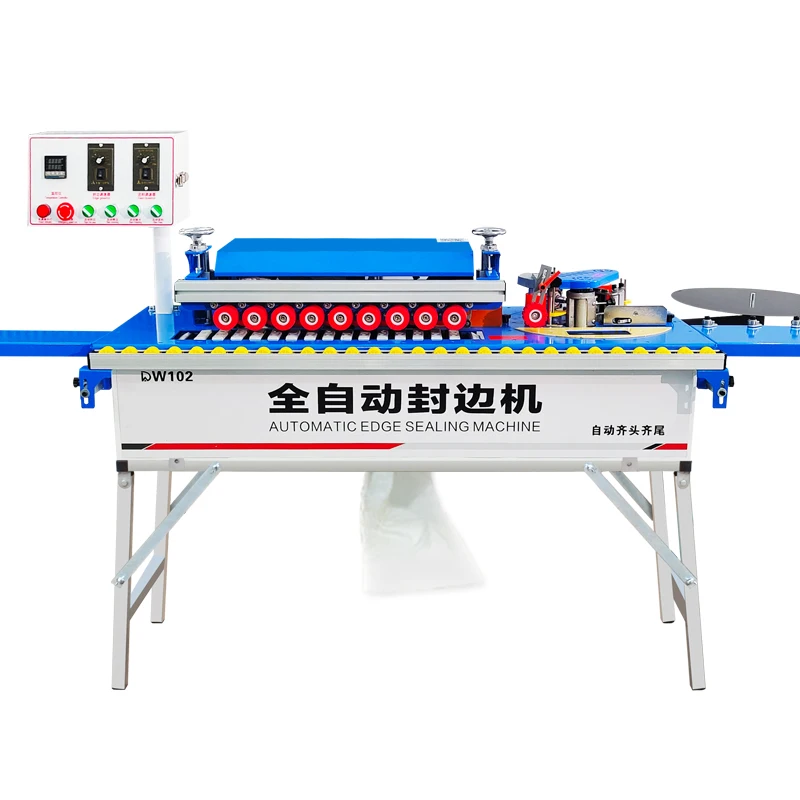
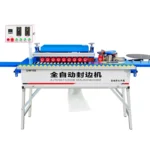
Compact Line Integration — The DW102 Mini Automatic Edge Banding Machine fits within a 128cm footprint while covering curved and straight edge banding, letting you plan station spacing and material flow before the line is built.
| Parameter | Value |
|---|---|
| Model | DW102 |
| Product Type | Mini Automatic Edge Banding Machine |
| Total Power | 3800W |
| Voltage | 220V (basis to be confirmed against local supply) |
| Edge Banding Thickness Range | 0.3–3mm |
| Edge Banding Height | 0–50mm |
| Minimum Sheet Length | 25cm |
| Minimum Sheet Width | 5cm |
| Trimming Power | 650W × 2 |
| Polishing Power | 180W × 2 |
| Vacuum Power | 1200W |
| Glue Pot Capacity | 1000ml |
| Air Source Pressure | 0.5–0.8 MPa |
| Product Size (L×W×H) | 128 × 47 × 69 cm |
| Product Weight | 75 kg |
| Key Features | Curved and straight edge banding, automatic head and tail cutting, edge trimming, polishing, vacuum hold |
| Control Panel Language | Chinese and English standard; Spanish and other languages customizable |
| Application | Material or Output |
|---|---|
| Cabinet door and carcass edge finishing | MDF, particleboard, plywood with PVC or veneer banding |
| Curved panel edge banding for shaped furniture components | Blockboard, MDF, polymer door blanks |
| Small-batch custom furniture production lines | Solid wood panels and engineered board substrates |
| Phased workshop automation from manual to machine banding | Medium density fiberboard, plywood, particleboard |
Matching throughput between stations prevents bottlenecks that no single machine spec sheet will warn you about.
I once worked with a buyer who sourced a panel saw from one supplier and an edge banding machine production line station from another. The saw could cut panels faster than the bander could process them, so partially edged boards piled up on the floor waiting. The bander itself was fine — the problem was that nobody had checked whether its feed capacity aligned with upstream output. When you are planning an edge banding machine production line, the feed speed and cycle time of each station must be validated against its neighbors [NEED_CITE: production line throughput balancing principles for woodworking]. A compact machine like the DW102 has a clearly defined processing envelope — minimum sheet dimensions of 25cm by 5cm, banding thickness from 0.3 to 3mm — which lets you calculate whether it keeps pace with your cutting and boring stations before you commit to a layout.
The DW102 occupies a floor area of roughly 128 × 47cm, which matters when you are fitting an edge banding machine production line into an existing workshop. A smaller footprint means shorter conveyor runs between the panel saw and the banding station, reducing the distance operators carry partially finished panels. In phased expansions where a workshop adds one automated station at a time, this machine can slot into a gap between existing equipment without requiring a full floor plan redraw.
Many production lines dedicate separate stations to curved and straight edge work, which doubles the floor space consumed by banding operations. The DW102 handles both curved and straight profiles with automatic head and tail cutting in a single pass. For a cabinet maker running a mix of rectangular carcass panels and shaped door components, this consolidation means one operator can manage both product types without walking between machines [NEED_CITE: woodworking edge banding process for curved and straight profiles].
The total power draw of 3800W across all stations — trimming motors at 650W each, polishing at 180W each, vacuum at 1200W — tells you what electrical circuit this station needs. If your upstream panel saw already draws heavily from the same supply, you need to confirm the panel is rated for the combined load before installation. The air source requirement of 0.5–0.8 MPa means the machine needs a dedicated compressed air line or a shop-wide system with sufficient residual capacity after feeding pneumatic clamps and dust extraction on neighboring stations. The glue pot holds 1000ml, which suits short to medium production runs; for all-day continuous operation, you will want to confirm refill intervals against your shift length. Edge banding thickness from 0.3 to 3mm covers standard PVC and veneer materials used in cabinet and furniture production, and the 0–50mm banding height range accommodates most panel thicknesses in that category.
When a machine arrives at a factory and the local voltage does not match its motor rating, the options are limited: ship it back, source a transformer, or leave it idle. I have seen workshops lose weeks of production because a 220V machine was plugged into a 380V supply without verification [NEED_CITE: voltage mismatch consequences in industrial equipment installation]. The same applies to compressed air — if the shop airline cannot sustain 0.5 MPa at the point of connection, the pneumatic actuators on the trimming and cutting units will not cycle reliably, producing inconsistent edge finishes that show up only during assembly.
The DW102 sits within a product family that ranges from entry-level to full-function pre-milling models, so a workshop can start with this compact station and move to a higher-capacity bander from the same manufacturer as volume grows — without retraining operators on a different control interface. Voltage and control panel language are confirmed before the production order is placed, so the machine arrives ready to commission. The four-stage quality check covers incoming materials through pre-shipment verification, and every unit ships with a factory test record run on the substrate you specify. Engineer-led configuration support means the quotation includes a recommendation on whether this model matches your line throughput or whether a higher-tier station is warranted.
To size this machine correctly within your edge banding machine production line, share the panel materials you process most often, the thickness range of your typical boards, and the feed speed of your upstream panel saw. Confirm the voltage and frequency at your facility, the language your operators need on the control panel, and whether curved edge work is part of your regular output. If you have an existing boring or drilling station downstream, its cycle time helps determine whether this banding station keeps pace.
Q: How does this machine’s throughput align with upstream panel saws and downstream boring machines?
A: The DW102 processes panels within a defined size and thickness envelope. To validate line balance, we need the feed rate of your panel saw and the cycle time of your boring station. We then confirm whether this edge banding station can accept panels at the rate your cutting station produces them without creating a queue on the shop floor.
Q: What voltage and frequency must be confirmed before the machine ships?
A: We confirm the exact voltage, phase, and frequency at your facility before the production order is released. This prevents the situation where a machine arrives and cannot be powered without an additional transformer. The electrical schematic shipped with the machine reflects the confirmed supply specification.
Q: Can the control panel language match what our operators read?
A: Chinese and English are standard on the control panel. Spanish and other languages are available as custom options. We confirm the required language during the quotation stage so the panel is configured before the machine leaves the factory, avoiding commissioning delays on site.
Q: What floor space and air supply does this station need within an existing line?
A: The machine footprint is 128 × 47 × 69cm, plus operator clearance for panel infeed and outfeed. The compressed air requirement is 0.5–0.8 MPa at the connection point. We recommend verifying that your shop air system has sufficient residual capacity after supplying other pneumatic equipment on the line.
Q: How do we verify edge quality on our specific panel material before placing a full line order?
A: We run sample panels in your actual substrate — MDF, plywood, particleboard, or blockboard — with your chosen banding material and record the results. The factory test record ships with the machine. You can also arrange a factory visit to observe the test run and inspect edge adhesion and trimming quality in person.
* Detailed technical specifications vary by model. Contact us for the full parameter sheet and customization options.
Heavy-duty wooden crate with moisture-proof lining and steel strapping. Seaworthy standard for safe ocean freight.
Standard models: 15-20 working days. Custom OEM orders: 25-35 working days from deposit confirmation.
FOB Qingdao / Tianjin. EXW, CIF available. T/T, L/C, Western Union accepted. Flexible payment terms for long-term partners.
We export to 100+ countries across Europe (Germany, Spain, Italy), Americas (USA, Mexico, Brazil, Argentina), Southeast Asia (Vietnam, Indonesia, Thailand), Africa (Nigeria, Egypt, South Africa), and the Middle East. Full customs documentation and export compliance support included.
Your logo on machine body, control panel and packaging. Full white-label production available.
Support 110V/60Hz, 220V/50Hz, 380V/50Hz, 440V/60Hz and other local electrical standards.
Modify table size, motor power, cutting capacity and other parameters per your production requirements.
Control panel available in English, Spanish, French, Arabic, Russian and other languages on request.
Custom paint color, machine casing design and aesthetic modifications to match your brand identity.
Bundled tooling sets, spare parts kits, installation tools and custom accessories for your market needs.
Fill in your requirements and our sales team will respond within 24 hours with a formal quotation and full technical specifications.