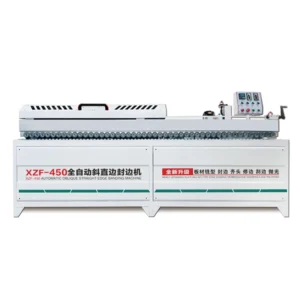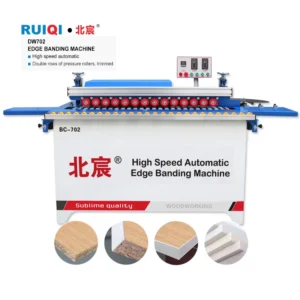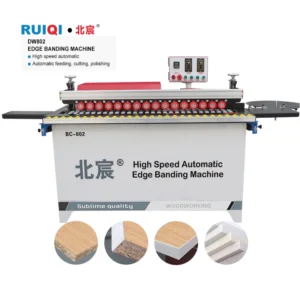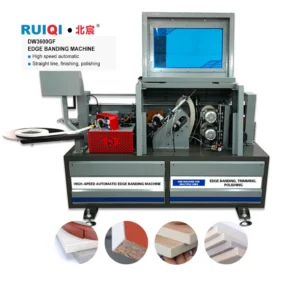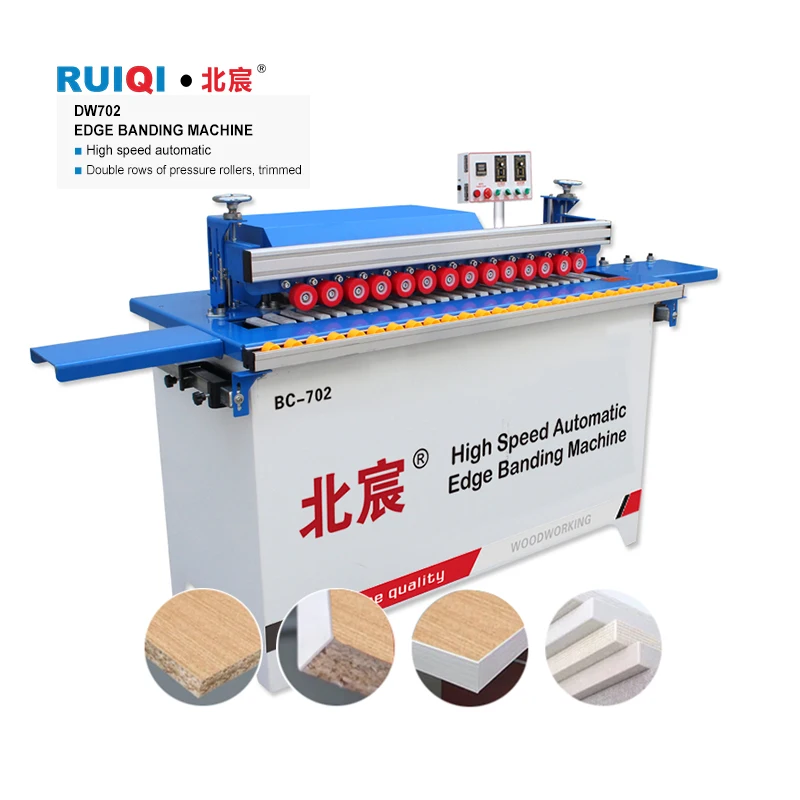
DW702 High Speed Automatic Edge Banding Machine, 3800W, 220V/380V, 0.3–3mm banding thickness — integrates gluing, trimming, and polishing in a 120×55×110cm footprint for phased line builds.
Line layout proposals with throughput verification and pre-shipment test records on your substrate are standard before dispatch.
Integrated Line Station — engineered with patented cutting mechanisms and verified tolerance to slot into phased furniture production builds without bottlenecking upstream or downstream equipment.
| Parameter | Value |
|---|---|
| Model | DW702 |
| Product Type | High Speed Automatic Edge Banding Machine |
| Total Power | 3800W |
| Voltage | 220V / 380V / Customizable |
| Trimming Motor Power | 800W × 2 |
| Polishing Motor Power | 180W × 2 |
| Transmission Motor Power | 140W |
| Vacuum Motor Power | 1200W |
| Glue Pot Capacity | 1000 ml |
| Air Source Pressure | 0.4–0.8 MPa |
| Edge Banding Thickness Range | 0.3–3 mm |
| Edge Banding Height Range | 0–50 mm |
| Minimum Sheet Length | 25 cm |
| Minimum Sheet Width | 10 cm |
| Overall Dimensions (L×W×H) | 120 × 55 × 110 cm |
| Net Weight | 105 kg |
| Key Features | Edge banding, trimming, polishing, automatic head and tail cutting, vacuum-assisted feed |
| Control System / Language Options | Chinese and English standard; other languages customizable |
| Plug Options | EU / USA / AU / UK available |
| Feed Speed | (basis to be confirmed) |
| Tolerance | (basis to be confirmed) |
| Application | Material or Output |
|---|---|
| Cabinet door edge banding | MDF and melamine-faced particleboard up to 3 mm PVC or veneer tape |
| Plywood furniture panel finishing | Plywood panels requiring trimming and polishing in one pass |
| Small-batch solid wood edge treatment | Solid wood panels with narrow-profile banding from 0.3 mm |
| Polymer door panel production | Polymer composite substrates with standard thickness edge tape |
| Workshop-level phased line builds | Mixed substrate runs at furniture and joinery shops |
The edge bander must digest boards exactly as fast as the panel saw feeds them out.
I once stood on the floor of a board plant in Kenya where a brand-new automatic edge bander sat idle half the day. The panel saw upstream pushed sheets faster than the banding station could accept them, and boards piled up on roller tables until operators were manually shuffling stacks just to keep the saw running. Nobody had matched the throughput. The edge banding machine production line was designed on paper, but the cycle time between stations had never been calculated against the actual cutting rhythm of the saw. [NEED_CITE: material flow balancing between panel saw and edge banding stations]
When you plan a line rather than a standalone purchase, every station is a link. A faster saw does not help if the bander chokes. A slower bander does not save money if boards are waiting.
The DW702 occupies a 120 × 55 cm footprint, which matters when you are arranging an edge banding machine production line inside a limited workshop bay. Compact dimensions allow the bander to sit directly beside a sliding table saw and a boring station without long transfer tables eating up floor space. Vacuum-assisted feed holds smaller panels firmly, so the minimum sheet width of 10 cm means operators do not need to batch oversized boards just to keep the machine stable.
Many workshops buy a bander first, then add a boring machine six months later, only to discover the feed heights do not align. With voltage configurable between 220V and 380V and plug types selectable across EU, USA, AU, and UK standards, the DW702 can share the same electrical infrastructure as future stations. You wire the workshop once and add equipment without pulling new cables or changing transformer taps. [NEED_CITE: electrical standardization across multi-station woodworking lines]
The dual 800W trimming motors handle the bulk of material removal after the band is applied, leaving the 180W polishing motors to clean up residual adhesive and smooth the edge. This separation matters: if one motor does both jobs, you sacrifice either trim quality or surface finish. A 1000 ml glue pot holds enough hot-melt adhesive for continuous runs on standard PVC and melamine tape without frequent refills interrupting the line rhythm. Edge banding thickness from 0.3 mm to 3 mm covers everything from thin veneer strips to heavy PVC bumper edges used on commercial cabinet doors. The air pressure range of 0.4–0.8 MPa aligns with most workshop compressor outputs, so a dedicated compressor is rarely needed if the existing supply is stable.
Purchasing an edge bander in isolation and bolting it next to existing machinery often leads to mismatched conveyor heights, incompatible dust extraction ports, or control panels in a language the line operator cannot read. I have watched factories lose entire mornings re-routing boards between stations because nobody confirmed the feed height of the bander against the outfeed table of the saw. The result is not a broken machine but a broken line, where operators become material handlers instead of machinists. [NEED_CITE: common commissioning failures in piecemeal woodworking line assembly]
In-house manufacturing with patented cutting mechanisms means the tolerance is verifiable on your own substrate before the machine ships, not just claimed on a spec sheet. Full product family coverage — from entry-level banders to full-function pre-milling models — lets a workshop scale within one supplier, keeping control panel layouts and electrical standards consistent. Voltage, plug, and language customization are treated as standard order parameters rather than special requests. Four-stage quality control with pre-shipment verification includes running your actual panel samples through the machine and documenting the result. Configuration proposals from engineers arrive with a formal quotation within one working day, so line planning is not held up waiting for pricing.
Share the substrate types and panel thickness range your workshop processes most often, along with the existing or planned upstream saw and downstream boring station. Specify the local voltage and frequency, preferred control panel language, and whether you need a line layout proposal showing material flow between stations. If you have samples of the edge banding material you intend to use — PVC, melamine, or veneer — include the thickness so the trimming and polishing setup can be configured before the machine leaves the factory.
Q: How does the DW702 throughput align with upstream panel saws and downstream boring machines?
A: Throughput depends on the feed speed setting and panel size in your actual production mix. We calculate the cycle time per station based on your typical board dimensions and match the DW702 feed rate against the saw output and boring station intake so no single machine becomes the bottleneck on the line.
Q: What is the phased investment path from this edge bander to a full line?
A: You start with the DW702 as the banding station, wire the workshop to a shared voltage standard, and add sliding table saws and boring machines later. Because plug type, voltage, and control language are set at the outset, each new station plugs into the same infrastructure without electrical rework.
Q: Can voltage, plug type, and control language be standardised across all machines in a line?
A: Yes. The DW702 supports 220V or 380V with EU, USA, AU, and UK plug options, and the control panel defaults to Chinese and English with other languages configurable. We apply the same configuration across every machine in your line order so operators see a consistent interface.
Q: How is material flow planned when the bander sits beside other stations?
A: We draft a line layout showing the DW702 positioned relative to the saw outfeed and boring station infeed, accounting for its 120 × 55 × 110 cm dimensions and operator access on the feed side. Roller conveyors or transfer tables fill any gap so panels move between stations without manual lifting.
Q: What commissioning support is provided before and after the line ships?
A: Before dispatch, we run your panel samples through the DW702 and document trimming quality, glue adhesion, and polish finish in a pre-shipment test record. After arrival, installation guidance covers electrical connection, air supply setup, and first-run parameter adjustment for your specific edge banding material.
* Detailed technical specifications vary by model. Contact us for the full parameter sheet and customization options.
Heavy-duty wooden crate with moisture-proof lining and steel strapping. Seaworthy standard for safe ocean freight.
Standard models: 15-20 working days. Custom OEM orders: 25-35 working days from deposit confirmation.
FOB Qingdao / Tianjin. EXW, CIF available. T/T, L/C, Western Union accepted. Flexible payment terms for long-term partners.
We export to 100+ countries across Europe (Germany, Spain, Italy), Americas (USA, Mexico, Brazil, Argentina), Southeast Asia (Vietnam, Indonesia, Thailand), Africa (Nigeria, Egypt, South Africa), and the Middle East. Full customs documentation and export compliance support included.
Your logo on machine body, control panel and packaging. Full white-label production available.
Support 110V/60Hz, 220V/50Hz, 380V/50Hz, 440V/60Hz and other local electrical standards.
Modify table size, motor power, cutting capacity and other parameters per your production requirements.
Control panel available in English, Spanish, French, Arabic, Russian and other languages on request.
Custom paint color, machine casing design and aesthetic modifications to match your brand identity.
Bundled tooling sets, spare parts kits, installation tools and custom accessories for your market needs.
Fill in your requirements and our sales team will respond within 24 hours with a formal quotation and full technical specifications.