EDGE BANDING MACHINE
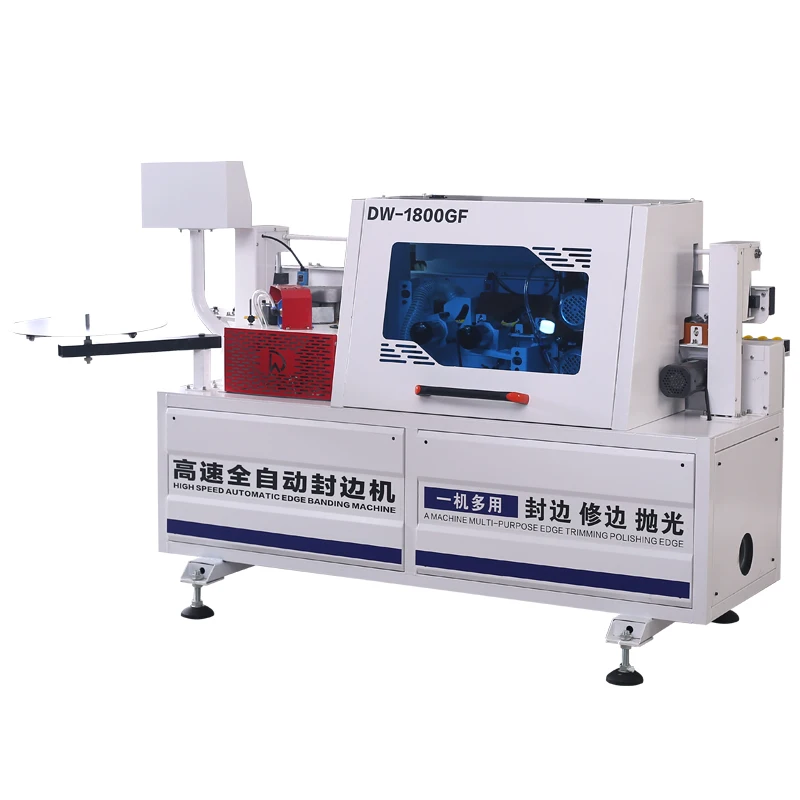
DW1800 Automatic Edge Banding Machine, 0–14 m/min feed speed, 0.3–3 mm banding thickness, double-sided gluing — engineered as a matched station within a complete panel processing line, with feed height and throughput synchronized to upstream saws and downstream boring units. Profile tracking delivers consistent four-corner rounding across MDF, particleboard, and plywood in a single pass. Four-stage QC with pre-shipment verification ensures tolerance documentation before dispatch.
Engineer-led configuration — the DW1800 is specified only after reviewing your panel samples and edge strip materials, preventing the motor burnout I once saw when a light-duty trimmer met heavy PVC in a Brazilian cabinet plant.
| Parameter | Value |
|---|---|
| Model | DW1800 |
| Product Type | Automatic Edge Banding Machine |
| Total Power | 4.9 kW |
| Voltage Options | 380V / 220V / 415V (configurable from 110V to 440V) |
| Feed Speed | 0–14 m/min |
| Edge Banding Height Range | 0–50 mm |
| Edge Banding Thickness Range | 0.3–3 mm |
| Minimum Sheet Length | 200 mm |
| Minimum Sheet Width | 100 mm |
| Glue Pot Capacity | 4000 ml |
| Gluing Method | Double-sided gluing |
| Standard Functions | Gluing, end cutting, rough trimming, fine trimming, profile tracking, scraping, polishing |
| Trimming Motor Power | 800 W × 2 |
| Trimming Motor Speed | 24,000 r/min |
| Polishing Motor Power | 380 W × 2 |
| Vacuum Power | 550 W |
| Air Source Pressure | 0.4–0.6 MPa |
| Transmission Power | 180 W |
| Edge Feed Power | 160 W |
| Overall Dimensions (L×W×H) | 2200 × 650 × 1250 mm |
| Net Weight | 320 kg |
| Control Panel Language | Chinese and English standard; other languages customizable |
| Assembly State | Fully assembled, pre-shipping test |
| Certification | CE, ISO 9001 |
| Application | Material or Output |
|---|---|
| Custom furniture panel edge banding | MDF, particleboard with PVC or melamine edge strips |
| Cabinet door and carcass production | Plywood and melamine-faced board with veneer or ABS banding |
| Panel processing plant line integration | Mixed substrate batches requiring consistent edge finish |
| Workshop scaling from manual to automated | Solid wood panels and organic glass plates within thickness range |
A single edge bander specified in isolation almost always creates a bottleneck or idle time at the stations before and after it.
I have watched cabinet factories receive machines that technically work perfectly on their own but cannot accept panels from the upstream panel saw at the same feed height, forcing operators to manually reposition every board. The DW1800 automatic edge banding machine production line is configured as a station within a matched sequence, where feed height, panel thickness range, and throughput cadence are verified against the cutting and boring equipment already on your floor [NEED_CITE: production line throughput matching principles for panel furniture].
When a furniture factory plans a complete panel processing sequence, the DW1800 sits between the panel saw and the multi-boring machine. Its 0–14 m/min feed speed range allows synchronization with upstream cutting output and downstream assembly stations. The 0.3–3 mm edge banding thickness range and 0–50 mm height capacity cover the standard material mix in cabinet and wardrobe production without requiring machine changes between batches.
The 200 mm minimum sheet length and 100 mm minimum sheet width define the smallest panel the DW1800 can process, which must align with the panel saw’s minimum cut size and the boring machine’s clamping range. A mismatch here means small drawer fronts or narrow shelf panels must be edged manually, breaking the automatic edge banding machine production line flow and creating a hidden rework station that delays the entire batch [NEED_CITE: panel furniture production line station compatibility standards].
The 4000 ml glue pot with double-sided gluing applies adhesive to both the panel edge and the banding strip simultaneously. In a line environment where the edge bander must keep pace with a panel saw producing continuously, the larger glue reservoir reduces refill interruptions. Profile tracking rounds all four corners in the same pass, so panels move directly to the boring station without secondary edge finishing.
The DW1800 carries rough trimming, fine trimming, profile tracking, scraping, and polishing as standard functions. The 800 W trimming motors at 24,000 r/min remove excess banding material in stages, producing a finished edge that does not require hand scraping before assembly. This matters in a line layout because any station that demands manual rework upstream of boring or hardware insertion slows every panel behind it in the queue.
The trimming motor is the component most likely to fail first when the machine meets real production conditions.
In that Brazilian cabinet factory I mentioned, the edge bander was quoted for standard PVC on melamine-faced particleboard, but the actual daily workload involved heavier PVC strips on abrasive substrates. The trimming cutter burned out within weeks because the motor specification had not been verified against the real material. When one station in a production line goes down, every upstream and downstream station idles, and the output loss compounds across the entire shift [NEED_CITE: edge banding motor failure causes in high-volume panel processing].
Every DW1800 configuration is verified against actual board samples and edge strip specifications before the quotation is finalized. The four-stage QC process covers incoming material inspection, in-process checks, finished product verification, and pre-shipment testing on your target substrate. Electrical schematics and voltage confirmation are issued before production begins, so the machine arrives with the correct power supply for your facility. Factory visits for live sample processing and line layout consultation are available before order commitment. Spare parts lists and maintenance manuals in the agreed language ship with the machine, and installation guidance covers the 0.4–0.6 MPa air source requirement and 320 kg floor loading.
To configure the DW1800 as a matched station in your automatic edge banding machine production line, send your target panel materials with thickness and edge strip specifications, the upstream panel saw model and its output rate, your downstream boring station requirements, and your local voltage and frequency. Include your workshop floor dimensions if you need line layout consultation.
Q: How do I match the DW1800 feed speed with my existing panel saw and boring machine?
A: Provide the panel saw output rate in panels per hour and the boring machine cycle time. The 0–14 m/min feed speed range on the DW1800 is then set to balance throughput across all three stations, preventing bottlenecks. We verify compatibility during the configuration proposal stage before any order is placed.
Q: What is the recommended phased investment sequence for a complete panel processing line?
A: Most furniture factories start with the panel saw and edge bander as the first two stations, then add boring and hardware insertion as order volume grows. The DW1800 is specified with future station additions in mind, so feed height and panel dimensions remain compatible when you expand the line.
Q: How is voltage and frequency confirmed before production begins?
A: We issue an electrical schematic and voltage confirmation document showing the exact supply specification for your facility. The DW1800 is configurable from 110V to 440V, and frequency is confirmed for your local grid standard before the machine enters production.
Q: What control panel language options are available for operator commissioning?
A: The standard control panel ships in Chinese and English. Additional languages are customizable based on your operator requirements. The language specification is confirmed during the quotation stage so the machine arrives ready for immediate commissioning without translation delays.
Q: How are spare parts and technical support handled after installation?
A: A spare parts list ships with the machine identifying trimming motors, polishing units, and consumables. Installation guidance covers the 4.9 kW power connection and 0.4–0.6 MPa air source setup. After-sales support includes remote troubleshooting and parts dispatch based on the documentation package provided at shipment.
* Detailed technical specifications vary by model. Contact us for the full parameter sheet and customization options.
Heavy-duty wooden crate with moisture-proof lining and steel strapping. Seaworthy standard for safe ocean freight.
Standard models: 15-20 working days. Custom OEM orders: 25-35 working days from deposit confirmation.
FOB Qingdao / Tianjin. EXW, CIF available. T/T, L/C, Western Union accepted. Flexible payment terms for long-term partners.
We export to 100+ countries across Europe (Germany, Spain, Italy), Americas (USA, Mexico, Brazil, Argentina), Southeast Asia (Vietnam, Indonesia, Thailand), Africa (Nigeria, Egypt, South Africa), and the Middle East. Full customs documentation and export compliance support included.
Your logo on machine body, control panel and packaging. Full white-label production available.
Support 110V/60Hz, 220V/50Hz, 380V/50Hz, 440V/60Hz and other local electrical standards.
Modify table size, motor power, cutting capacity and other parameters per your production requirements.
Control panel available in English, Spanish, French, Arabic, Russian and other languages on request.
Custom paint color, machine casing design and aesthetic modifications to match your brand identity.
Bundled tooling sets, spare parts kits, installation tools and custom accessories for your market needs.
Fill in your requirements and our sales team will respond within 24 hours with a formal quotation and full technical specifications.