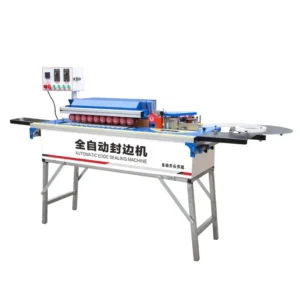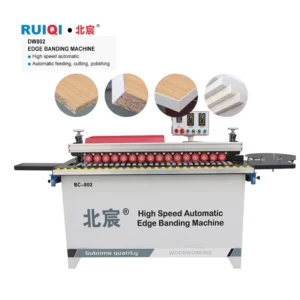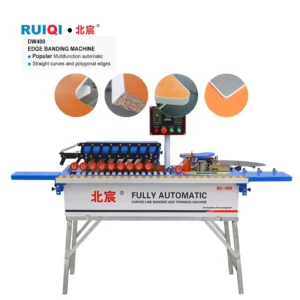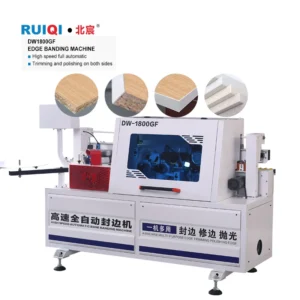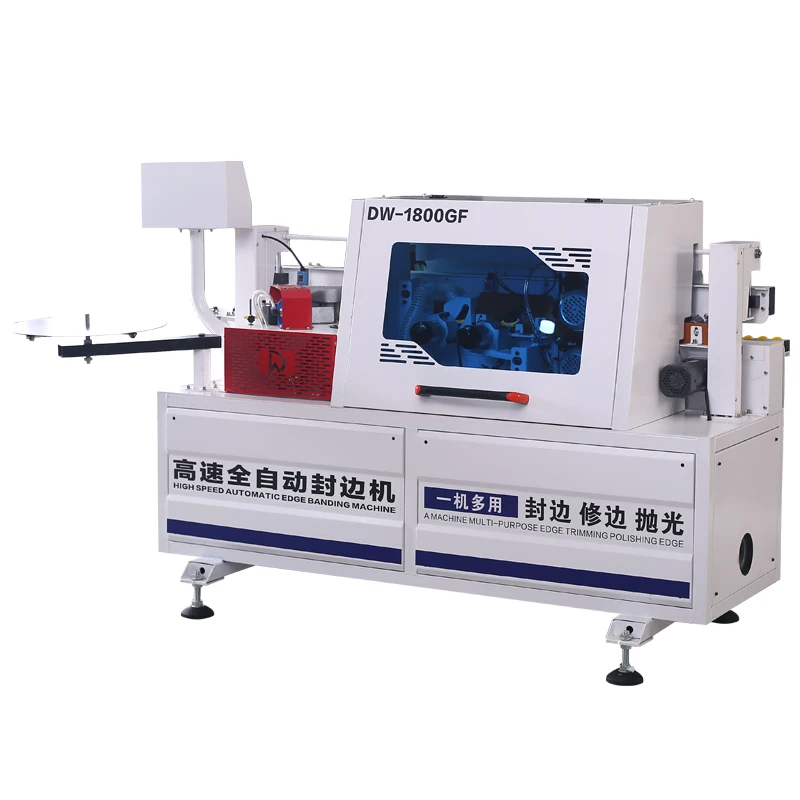
DW1800 Automatic Edge Banding Machine, 380V/220V/415V, 0-14M/min Feed Speed, 0.3-3MM Banding Thickness — designed for complete production line integration with matched throughput between upstream saws and downstream boring stations.
Engineer-led configuration aligns feed speed, voltage and workstation layout with your existing line, backed by pre-shipment test records and formal quotation within 24 hours.
Roll-Ball Differential Guide — The DW1800 automatic edge banding machine uses a high-strength extruded aluminum alloy workstation with oxidation-treated surfaces, engineered to maintain feed accuracy across continuous line operation without table deformation.
| Parameter | Value |
|---|---|
| Model | DW1800 |
| Product Type | Automatic Edge Banding Machine |
| Total Power | 4.9 kW |
| Voltage | 380V / 220V / 415V (configurable) |
| Feed Speed | 0–14 m/min |
| Minimum Sheet Length | 200 mm |
| Minimum Sheet Width | 100 mm |
| Edge Banding Height | 0–50 mm |
| Edge Banding Thickness | 0.3–3 mm |
| Trimming Power | 800W × 2 at 24,000 r/min |
| Polishing Power | 380W × 2 |
| Vacuum Power | 550W |
| Air Source Pressure | 0.4–0.6 MPa |
| Glue Pot Capacity | 4000 ml |
| Product Size | 2200 × 650 × 1250 mm |
| Product Weight | 320 kg |
| Table Guide | Roll-ball differential structure |
| Main Blade Adjustment | Precision instrument visual display |
| Standard Features | Double-sided gluing, top/bottom trimming, top/bottom polishing, front/rear alignment, flexible edge scraping, dust extraction |
| Application | Material or Output |
|---|---|
| Custom cabinet panel edging | MDF and particleboard with PVC edge banding |
| Wardrobe door production | Plywood panels with veneer or melamine strips |
| Office furniture components | ABB boards and organic glass plates |
| Solid wood panel finishing | Solid wood boards with matching thickness banding |
| Phased line integration | Panel output matching upstream sliding table saw throughput |
The bottleneck is rarely the edge bander itself — it is the mismatch between stations.
When a workshop adds an automatic edge banding machine production line without checking upstream saw output or downstream boring capacity, boards accumulate at the outfeed. Fresh glue edges get scratched, operators slow the feed to compensate, and the entire line runs below its designed capacity. The DW1800 offers a variable feed speed from 0 to 14 m/min, but that range only matters if it is set to balance the stations before and after it [NEED_CITE: material flow synchronization in panel processing lines]. An edge bander running faster than the panel saw can cut simply creates a queue of unprocessed boards on the floor.
Planning an automatic edge banding machine production line starts with mapping each station’s cycle time. If a sliding table saw processes twelve panels per minute, the edge bander feed speed must be set so that trimmed panels arrive at the boring machine at the same rate. The DW1800’s variable feed control allows operators to dial in the exact speed rather than running at maximum and creating a pile-up downstream. This balance is what separates a collection of standalone machines from a synchronized line.
Many workshops begin with a panel saw and add an automatic edge banding machine production line station by station as order volume grows. The DW1800 is configured for this phased approach: its 380V/220V/415V voltage options mean it can integrate into an existing electrical layout without requiring a facility-wide rewiring [NEED_CITE: industrial voltage configuration for phased equipment additions]. When the next boring machine or stacking station arrives, the edge bander’s working height and feed rate can be adjusted to accommodate the new neighbor without recalibrating the entire line.
The edge banding height range of 0–50 mm covers standard panel thicknesses used in cabinet and furniture production, from thin 3 mm MDF backs to 50 mm solid wood worktops. The trimming motors running at 24,000 r/min produce a clean cut on both PVC and veneer banding materials, reducing the need for manual touch-up before assembly. The roll-ball differential table guide keeps panels flat and aligned as they pass through each station, which matters when tolerances at the boring stage depend on consistent edge geometry. The 4000 ml glue pot capacity supports extended production runs without frequent refills, and the double-sided gluing system ensures uniform adhesive coverage regardless of whether the banding is thin PVC or thicker wood veneer. The dust extraction port at 550W vacuum power connects to the workshop’s central collection system, keeping the trimming and polishing zones clear of debris that would otherwise scratch the freshly banded surface.
Workshops that select an edge bander based solely on standalone specifications often discover the mismatch after installation. A machine rated for higher feed speed than the upstream saw can supply creates idle time at the bander, while one that runs slower than the downstream borer can accept forces operators to batch panels and delay the next operation [NEED_CITE: consequences of throughput mismatch in furniture production]. Panels that sit too long after gluing can develop cold joints in the adhesive, leading to edge delamination that is only discovered during assembly. Electrical incompatibility surfaces when a 220V machine arrives at a facility wired for 380V three-phase, leaving the equipment unusable until transformers are sourced and installed.
The DW1800 is manufactured in-house with patented cutting mechanisms and verified tolerance data, not rebranded from a third-party assembler. The full edge banding machine range from entry-level to full-function sits within one product family, so a workshop can scale its automatic edge banding machine production line without switching suppliers mid-expansion. Voltage, control panel language, and specifications are confirmed before production begins, eliminating the scenario where a machine arrives with unreadable displays or incompatible power requirements. A four-stage quality check covering incoming material, in-process assembly, finished product, and pre-shipment verification is completed for every unit. Configuration recommendations are engineer-led, with formal quotations typically provided within 24 hours of a detailed inquiry.
To configure the DW1800 within your automatic edge banding machine production line, provide the panel materials and thicknesses you process most frequently, the feed rate of your current or planned panel saw, and your facility’s voltage and frequency. Include the working height of any downstream boring or drilling stations so that material flow can be verified across all equipment before shipment.
Q: How does the DW1800 feed speed match with upstream panel saws and downstream boring machines?
A: The 0–14 m/min variable feed range allows operators to set the exact speed needed to balance input from the panel saw and output to the boring station. During commissioning, the feed rate is calibrated against measured throughput at adjacent stations to prevent panel queue build-up or idle time at any point in the line.
Q: What voltage configuration ensures compatibility across the entire production line?
A: The DW1800 is configurable for 380V, 220V, or 415V supply. Before production, an electrical schematic is issued confirming the exact voltage and frequency your facility provides, ensuring the edge bander matches the power specifications of your existing saws and borers without additional transformers.
Q: How to plan phased investment when building a complete edge banding and processing line?
A: The DW1800 is designed as a standalone unit that integrates into a growing line. Start with the panel saw and edge bander, then add boring and trimming stations as order volume increases. The adjustable working height and variable feed speed allow each new machine to be synchronized without replacing earlier equipment.
Q: What is the layout footprint requirement when integrating this edge bander into an existing line?
A: The machine occupies 2200 × 650 × 1250 mm, with additional clearance needed at the infeed and outfeed for panel handling. Line layout planning should account for operator access on both sides and material flow direction to ensure panels move continuously between stations without manual repositioning.
Q: How are spare parts managed for all stations in the production line to avoid bottlenecks?
A: A complete spare parts list is provided covering trimming blades, polishing wheels, glue pot seals, and wear items specific to the DW1800. For line-wide maintenance, we coordinate spare part recommendations across all stations so that downtime planning covers the entire production sequence rather than individual machines in isolation.
* Detailed technical specifications vary by model. Contact us for the full parameter sheet and customization options.
Heavy-duty wooden crate with moisture-proof lining and steel strapping. Seaworthy standard for safe ocean freight.
Standard models: 15-20 working days. Custom OEM orders: 25-35 working days from deposit confirmation.
FOB Qingdao / Tianjin. EXW, CIF available. T/T, L/C, Western Union accepted. Flexible payment terms for long-term partners.
We export to 100+ countries across Europe (Germany, Spain, Italy), Americas (USA, Mexico, Brazil, Argentina), Southeast Asia (Vietnam, Indonesia, Thailand), Africa (Nigeria, Egypt, South Africa), and the Middle East. Full customs documentation and export compliance support included.
Your logo on machine body, control panel and packaging. Full white-label production available.
Support 110V/60Hz, 220V/50Hz, 380V/50Hz, 440V/60Hz and other local electrical standards.
Modify table size, motor power, cutting capacity and other parameters per your production requirements.
Control panel available in English, Spanish, French, Arabic, Russian and other languages on request.
Custom paint color, machine casing design and aesthetic modifications to match your brand identity.
Bundled tooling sets, spare parts kits, installation tools and custom accessories for your market needs.
Fill in your requirements and our sales team will respond within 24 hours with a formal quotation and full technical specifications.