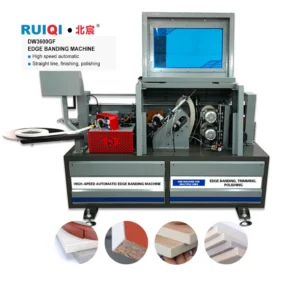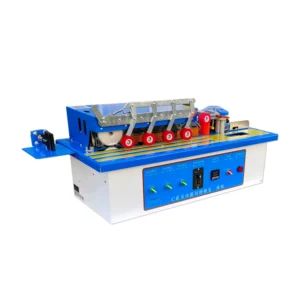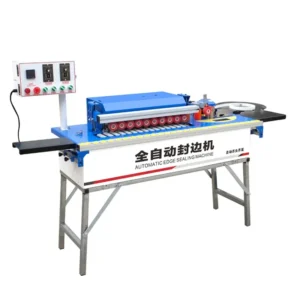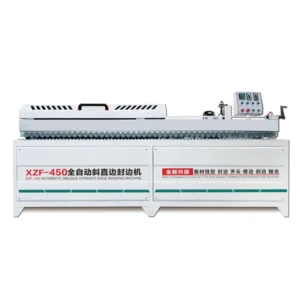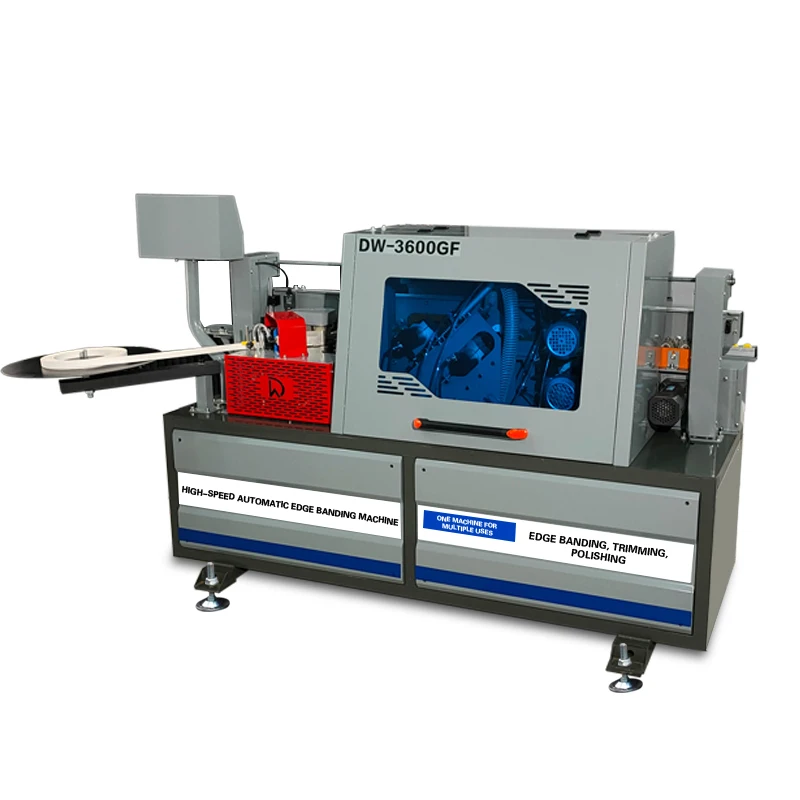
DW-3600GF Automatic Edge Banding Machine, 380V, 0-14m/min Feed, 0.3-3mm Band Thickness — engineered as a synchronized station within cabinet door and furniture production lines.
Engineer-led configuration and 24-hour formal quotation ensure this edge bander fits your line layout from day one.
Station-to-station pacing — the DW-3600GF feed speed range is specified to synchronize with upstream panel saws and downstream boring stations, preventing the bottleneck that turns high-capacity edge banders into idle assets on a mismatched line.
| Parameter | Value |
|---|---|
| Model | DW-3600GF |
| Product Type | Automatic Edge Banding Machine |
| Voltage & Frequency | 380V Three-Phase Four-Wire |
| Total Power | 4.9kW |
| Overall Dimensions (L×W×H) | 2200×650×1250mm |
| Net Weight | 320kg |
| Edge Banding Type | Straight Edge Banding |
| Edge Band Height Range | 0-50mm |
| Edge Band Thickness Range | 0.3-3mm |
| Minimum Panel Length | 200mm |
| Feed Speed | 0-14m/min |
| Trimming Motor Power | 800W×2 |
| Trimming Spindle Speed | 24000r/min |
| Polishing Motor Power | 400W×2 |
| Edge Banding Motor Power | 160W |
| Transmission Motor Power | 180W |
| Air Supply Requirement | 0.4-0.6 MPa |
| Standard Function Stations | Gluing, Trimming, Front and Rear Trimming, Scraping, Polishing, Vacuuming |
| Key Features | Straight edge processing, multi-language control panel options (Chinese, English standard; others customizable), plug options (EU, USA, AU, UK) |
| Application | Material or Output |
|---|---|
| Custom cabinet door production | MDF and particleboard panels with PVC or veneer edge banding |
| Small to mid-scale furniture manufacturing | Plywood and MDF boards for home furniture components |
| Panel processing plant integration | Straight edge finishing on particleboard and MDF at line-matched throughput |
| Turnkey cabinet factory deployment | Synchronized edge banding station between cutting and boring operations |
A fast edge bander starved by a slow saw produces worse panels than a slower machine running steadily.
In my years planning lines across the Yangtze Delta workshops, I watched factory owners chase the highest feed speed number on the spec sheet, only to find the automatic edge banding machine production line idling half the time. The upstream panel saw cuts at a fixed cadence. When the edge bander runs faster than what feeds it, the machine starts and stops constantly. Glue in the pot carbonizes during those idle stretches. Panels pile up on the conveyor waiting their turn, and the accumulated dust and contact marks score the surface before they even reach the banding station. [NEED_CITE: thermal degradation of hot-melt adhesive during intermittent operation cycles] The DW-3600GF runs at 0-14m/min, a deliberate ceiling that forces the line planner to calculate upstream and downstream matching rather than overspec a single station.
The DW-3600GF’s feed speed range of 0-14m/min sits within the output band of typical sliding table saws and beam saws used in small to mid-scale cabinet shops. When I lay out an automatic edge banding machine production line, I match this ceiling against the panel saw’s cuts-per-hour and the boring machine’s cycle time. If the saw produces 80 panels per hour and each panel requires roughly 30 seconds on the edge bander at a given feed speed, the stations stay synchronized without buffer tables piling stock between them. The goal is continuous flow, not maximum single-machine throughput.
Six integrated stations — gluing, trimming, front and rear trimming, scraping, polishing, and vacuuming — handle the complete straight edge process in one pass. This matters for line flow because a panel exits ready for the boring or hinge-drilling station without secondary handling. Each station has a dedicated motor: 800W×2 for trimming at 24000r/min, 400W×2 for polishing, and 160W for the banding feed itself. [NEED_CITE: edge banding quality requirements for downstream CNC assembly operations] The vacuuming station at the end clears trimming debris before it can migrate into the next machine’s work zone, which protects boring spindles and extends tool life across the line.
The 0.3-3mm edge band thickness range covers the PVC and veneer materials standard in cabinet door production, while the 0-50mm height range handles everything from 16mm particleboard shelf stock to 25mm MDF door panels. The minimum panel length of 200mm means small offcut pieces from nesting operations can pass through without jamming the feed chain — a frequent problem in lines that skip this check during layout. The trimming spindle speed at 24000r/min produces a clean cut on melamine-faced chipboard without chipping, which keeps rejection rates down before assembly. The 4.9kW total power draw is modest enough that most small factory electrical panels can absorb this automatic edge banding machine production line station without a dedicated transformer upgrade.
I have seen factories receive a machine, uncrate it, and discover the local compressor delivers 0.3 MPa when the unit requires 0.4-0.6 MPa. The glue roller pressure drops, the banding lifts on the trailing edge, and the operator blames the machine. The same pattern repeats with voltage: a 380V three-phase four-wire machine plugged into a delta-configured supply without neutral reference trips breakers on startup. [NEED_CITE: compressed air pressure requirements for pneumatic edge banding systems] These failures are not mechanical — they are planning failures that a correct line survey would have caught before the order was placed. The DW-3600GF’s electrical schematic and voltage confirmation document exist to prevent exactly this scenario, but only if the buyer provides accurate facility data before production begins.
The manufacturer’s four-stage QC — incoming material, in-process, finished product, and pre-shipment verification — catches assembly defects before the crate leaves Shandong. But QC cannot fix a machine that was specified incorrectly for the line it enters. The engineer-led configuration process requires the buyer to submit factory scale, processing requirements, and existing equipment details before a formal quotation arrives. This is how throughput matching happens: not by reading a brochure number, but by calculating actual panel flow against the 0-14m/min feed envelope and confirming that upstream cutting and downstream boring stations align. CE declaration and ISO 9001 documentation ship with every unit, providing the compliance paperwork importers need without delay.
Send your upstream panel saw model and its rated cuts-per-hour, the downstream boring station cycle time, and the exact panel dimensions and materials you run most often. Include your factory’s voltage and phase configuration, compressor output pressure, and available floor space with ceiling height. If you have existing conveyor heights or roller tables between stations, provide those measurements so the DW-3600GF infeed and outfeed alignment can be confirmed before the machine is built.
Q: How do I verify the DW-3600GF feed speed matches my panel saw output?
A: Calculate your saw’s panels-per-hour and divide into the total edge length per panel. Compare that to the DW-3600GF’s 0-14m/min range at your typical panel dimensions. If the numbers leave the edge bander idle more than a few seconds between panels, the saw is the constraint and adding speed at the banding station will not increase line output.
Q: Can I deploy this machine now and expand the line later?
A: The DW-3600GF operates as a standalone unit with its own infeed and outfeed, so it functions independently before a full line is assembled. When you add upstream cutting or downstream boring stations later, the 0-14m/min feed speed range provides room to synchronize without replacing the edge bander.
Q: What utility data do I need to confirm before ordering?
A: Provide your facility’s three-phase voltage and frequency, the available amperage on the dedicated circuit, and your compressor’s working pressure in MPa. The machine requires 380V three-phase four-wire power and 0.4-0.6 MPa air supply. Mismatches in either parameter will prevent commissioning.
Q: How much floor space should I allocate in the line layout?
A: The machine footprint is 2200×650×1250mm, but plan for operator access on the infeed side, maintenance clearance on the trimming motor side, and conveyor or roller table space on the outfeed. Exact clearance depends on your panel length and handling method between stations.
Q: What spare parts should I stock for continuous line operation?
A: Trimming cutters, scraping blades, glue roller covers, and polishing wheels are consumables that wear at rates depending on your edge band material and daily run hours. Request the spare parts list with your quotation and plan initial stock based on your production volume.
* Detailed technical specifications vary by model. Contact us for the full parameter sheet and customization options.
Heavy-duty wooden crate with moisture-proof lining and steel strapping. Seaworthy standard for safe ocean freight.
Standard models: 15-20 working days. Custom OEM orders: 25-35 working days from deposit confirmation.
FOB Qingdao / Tianjin. EXW, CIF available. T/T, L/C, Western Union accepted. Flexible payment terms for long-term partners.
We export to 100+ countries across Europe (Germany, Spain, Italy), Americas (USA, Mexico, Brazil, Argentina), Southeast Asia (Vietnam, Indonesia, Thailand), Africa (Nigeria, Egypt, South Africa), and the Middle East. Full customs documentation and export compliance support included.
Your logo on machine body, control panel and packaging. Full white-label production available.
Support 110V/60Hz, 220V/50Hz, 380V/50Hz, 440V/60Hz and other local electrical standards.
Modify table size, motor power, cutting capacity and other parameters per your production requirements.
Control panel available in English, Spanish, French, Arabic, Russian and other languages on request.
Custom paint color, machine casing design and aesthetic modifications to match your brand identity.
Bundled tooling sets, spare parts kits, installation tools and custom accessories for your market needs.
Fill in your requirements and our sales team will respond within 24 hours with a formal quotation and full technical specifications.