EDGE BANDING MACHINE
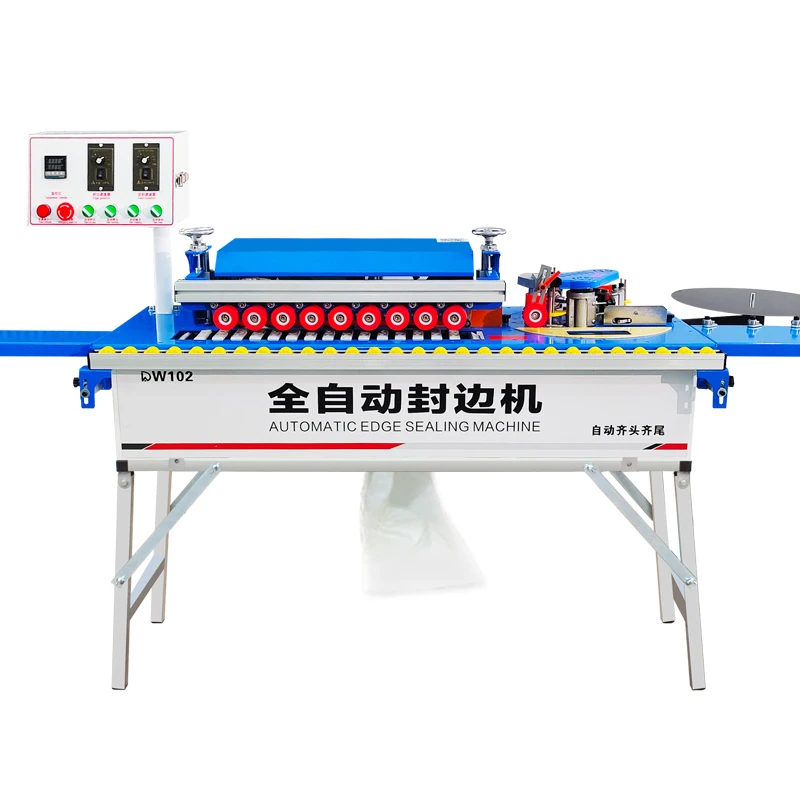
DW102 Automatic Curve and Linear Edge Banding Machine, 220V/380V, 0.3–3 mm edge thickness, 0–50 mm banding height — configured for phased production line integration where curved and straight edge stations merge into one footprint.
Voltage-Configurable Integration — this DW102 edge bander is specified with line-wide utility planning in mind, not as an isolated purchase.
| Parameter | Value |
|---|---|
| Model | DW102 |
| Product Type | Automatic Curve and Linear Edge Banding Machine |
| Total Power | 3800W |
| Voltage | 220V / 380V / customization available |
| Edge Banding Height | 0–50 mm |
| Edge Banding Thickness | 0.3–3 mm |
| Minimum Sheet Length | 25 cm |
| Minimum Sheet Width | 5 cm |
| Edge Motor Power | 20W |
| Transmission Motor Power | 60W |
| Trimming Motor Power | 650W × 2 |
| Polishing Motor Power | 180W × 2 |
| Vacuum Power | 1200W |
| Glue Pot Capacity | 1000 ml |
| Air Source Pressure | 0.5–0.8 MPa |
| Product Dimensions (L×W×H) | 128 × 47 × 69 cm |
| Net Weight | 75 kg |
| Key Features | Curved and straight edge banding, edge trimming, polishing, automatic head and tail cutting, vacuum hold-down |
| Control Panel Language | Chinese and English; other languages on request |
| Plug Options | EU, USA, AU, UK |
| Application | Material or Output |
|---|---|
| Cabinet door and drawer front production | MDF and plywood panels with straight and contoured edges |
| Small-format component edge finishing | Boards as small as 25 cm × 5 cm, such as shelving brackets and dividers |
| Panel furniture line integration | Particleboard and blockboard between panel saw and boring station |
| Polymer door profile edge sealing | PVC and polymer substrates with curved geometry |
| Custom workshop scaling | Solid wood panels in joinery environments transitioning to machine-assisted production |
The edge bander must match the output height of the panel saw and the infeed table of the boring machine, or operators waste cycles lifting or lowering every board.
When a factory plans a panel processing line, the tendency is to spec each machine independently. I have seen lines where the panel saw discharges at 900 mm and the edge bander infeed sits at 820 mm. Operators end up manually adjusting every sheet. On a run of several hundred panels, that adds up to lost time and increased handling damage. The DW102 is a compact automatic edge banding machine production line component designed to sit within a coordinated layout. Its 69 cm working height means it pairs with low-profile roller conveyors common in phased builds, and its small footprint allows placement directly downstream of a sliding table saw without consuming the floor space a full-size straight-line bander would require [NEED_CITE: typical roller conveyor height standards in panel furniture lines].
An Automatic Edge Banding Machine production line only runs as fast as its slowest station. The DW102 handles curved and straight edges in a single pass, which removes the need for a dedicated curved-edge machine downstream. That consolidation matters when you are calculating cycle times across saw, bander, and boring stations. If your panel saw cuts a batch and the edge bander cannot process them before the next batch arrives, the saw operator stands idle.
This unit’s minimum sheet dimension of 25 cm × 5 cm means it can process small offcuts and specialty components that would otherwise require a separate manual edge banding step. In a line producing custom cabinet interiors with mixed panel sizes, that flexibility prevents a bottleneck at the small-parts stage.
Compressed air and electrical load must be calculated for the entire line, not per machine in isolation. The DW102 requires 0.5–0.8 MPa air pressure for its pneumatic trimming and head/tail cutting functions. If your central compressor is already feeding a CNC nesting machine and a multi-boring unit, adding this edge bander means verifying the compressor can maintain pressure at all stations simultaneously [NEED_CITE: compressed air demand calculation methods for woodworking production lines].
The 3800W total power draw is modest relative to a full-size automatic bander, which eases the electrical load calculation when multiple machines share a distribution panel. Voltage customization from 220V to 380V ensures the unit matches the local supply standard without requiring a step-down transformer that would add cost and introduce a failure point.
The 650W × 2 trimming motors provide sufficient torque for clean cuts on PVC and wood veneer edge banding up to 3 mm thick, which covers the majority of materials in cabinet and furniture production. If your line runs predominantly 0.4 mm PVC on particleboard, the trimming load is light and motor wear is minimal. If you process 2 mm solid wood edging on plywood, those motors work harder and maintenance intervals shorten accordingly.
The 1000 ml glue pot capacity determines how often the operator must refill during a shift. On a line running standard 18 mm MDF panels with 0.4 mm PVC edging, this capacity supports extended runs without interruption. For thicker adhesive applications on solid wood edging, refill frequency increases. The vacuum hold-down system at 1200W secures panels through the trimming and polishing zones, which is critical when processing the minimum 25 cm sheet length where mechanical feed pressure alone may not prevent drift.
The 75 kg net weight and 128 × 47 × 69 cm dimensions mean this machine can be repositioned within the line layout as production requirements evolve. In a phased investment approach, a workshop might start with this unit handling both curved and straight work, then later add a dedicated high-speed straight-line bander and reassign the DW102 to curved and small-format duty.
Buying an edge bander based on its standalone price, then discovering it draws more air than the compressor can supply, is a pattern I encounter regularly. The line stops, the compressor overheats, and the factory calls it a machine problem when it is actually a planning problem. A compact unit like this one reduces that risk because its utility demands are proportional to a small-to-medium line, but the verification still has to happen before the order is placed [NEED_CITE: common causes of compressed air failure in multi-station woodworking lines].
Similarly, if the control panel language does not match what the operator reads, commissioning stalls. The DW102 ships with Chinese and English as standard, with Spanish, French, and other languages available on request. In a multi-country production line deployment, specifying the correct language at order stage avoids the situation where a machine sits idle waiting for a translated manual.
In-house manufacturing with patented cutting mechanisms means the edge banding tolerance is verifiable at the factory before the machine ships, not discovered on your floor during commissioning.
Full product family coverage from entry-level to full-function models allows a workshop to scale the line without changing suppliers, keeping utility connections and operator training consistent across stations.
Voltage, language, and plug type customization is confirmed at the quotation stage, so the machine arrives matching the local electrical standard and the operator’s language without field modifications.
Four-stage quality control with pre-shipment verification covers curved and straight edge functions, trimming accuracy, and vacuum performance under actual test conditions.
Engineer-led configuration recommendations ensure the DW102 is matched to your line’s throughput and material profile rather than sold as a standalone unit that may not integrate.
To position this edge bander correctly within your production layout, share the panel materials and thicknesses you process most frequently, the upstream panel saw model and its discharge height, and the downstream boring or drilling station if one is planned. Confirm your facility voltage and frequency, the compressed air capacity available at the installation point, and the preferred control panel language for your operators. If you are planning a phased line build, indicate which stations are current and which are planned for future phases.
Q: How do I match the DW102 throughput with my panel saw and boring machine cycle times?
A: Provide the cycle time of your upstream saw and downstream borer for your typical panel size. We calculate whether this edge bander processes panels fast enough to prevent queuing. If your line runs mixed sizes including the 25 cm minimum, the cycle calculation must account for those smaller panels separately.
Q: What voltage and frequency confirmation do I need for a multi-country line deployment?
A: Each installation site requires its own voltage and frequency specification at the order stage. The DW102 supports 220V and 380V with customization available. Confirming this per site prevents a situation where machines arrive at a facility with incompatible power infrastructure.
Q: How much floor space and utility capacity does this edge bander require in a line layout?
A: The unit occupies 128 × 47 × 69 cm plus conveyor clearance on both ends. Electrical draw is 3800W and compressed air demand is 0.5–0.8 MPa. We provide a line layout drawing showing placement relative to adjacent stations and utility connection points.
Q: Can I start with this edge bander and add more stations to the line later?
A: Yes. The compact footprint and moderate utility demands make this unit suitable as the first machine-assisted edge banding station in a phased build. When you add upstream or downstream stations later, the DW102 can remain in its original position or be reassigned to curved and small-format work.
Q: What OEM customization is available for distributor-led production line projects?
A: Control panel language, plug type, voltage configuration, and custom branding are all configurable at the order stage. For distributors installing complete lines in their territory, we provide technical documentation and spare parts backup to support local service capability.
* Detailed technical specifications vary by model. Contact us for the full parameter sheet and customization options.
Heavy-duty wooden crate with moisture-proof lining and steel strapping. Seaworthy standard for safe ocean freight.
Standard models: 15-20 working days. Custom OEM orders: 25-35 working days from deposit confirmation.
FOB Qingdao / Tianjin. EXW, CIF available. T/T, L/C, Western Union accepted. Flexible payment terms for long-term partners.
We export to 100+ countries across Europe (Germany, Spain, Italy), Americas (USA, Mexico, Brazil, Argentina), Southeast Asia (Vietnam, Indonesia, Thailand), Africa (Nigeria, Egypt, South Africa), and the Middle East. Full customs documentation and export compliance support included.
Your logo on machine body, control panel and packaging. Full white-label production available.
Support 110V/60Hz, 220V/50Hz, 380V/50Hz, 440V/60Hz and other local electrical standards.
Modify table size, motor power, cutting capacity and other parameters per your production requirements.
Control panel available in English, Spanish, French, Arabic, Russian and other languages on request.
Custom paint color, machine casing design and aesthetic modifications to match your brand identity.
Bundled tooling sets, spare parts kits, installation tools and custom accessories for your market needs.
Fill in your requirements and our sales team will respond within 24 hours with a formal quotation and full technical specifications.