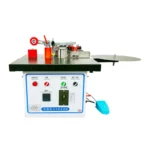
Engineer-led configuration ensures each station matches your line's throughput and utility plan before shipment, backed by four-stage QC verification and pre-shipment electrical documentation.
Custom Line Integration — this compact edge bander adapts to your factory’s electrical and material flow plan before it leaves our floor, not after arrival.
| Parameter | Value |
|---|---|
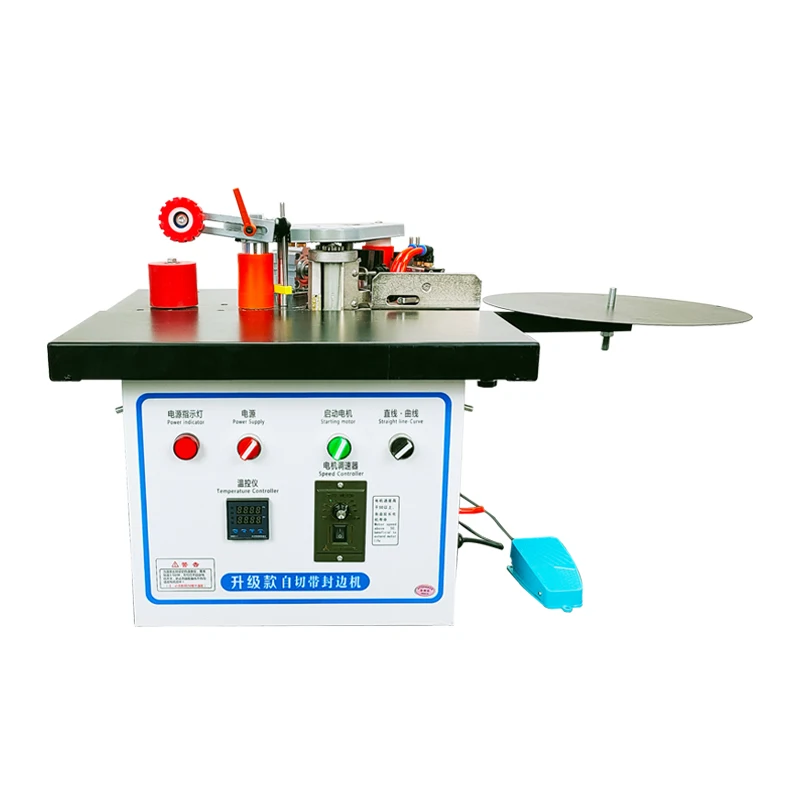
| Product Type | Manual Small Edge Banding Machine |
| Total Power | 1000W |
| Voltage & Frequency | 220V / 380V / customization available |
| Edge Banding Height Range | 0–50 mm |
| Edge Banding Thickness Range | 0.3–3 mm |
| Minimum Sheet Length | 25 cm |
| Minimum Sheet Width | 3 cm |
| Glue Pot Capacity | 1000 ml |
| Air Source Pressure | 0.5–0.8 MPa |
| Product Dimensions (L×W×H) | 50×50×47 cm |
| Net Weight | 22 kg |
| Assembly State | Fully assembled, benchtop portable unit |
| Language Options | Chinese, English; Spanish and other languages customizable |
| Edge Banding Capability | Curved and straight edges |
| Standards | CE; ISO 9001 |
| Application | Material or Output |
|---|---|
| Edge sealing for custom furniture panels | MDF and particleboard with PVC or melamine banding |
| Small-batch cabinet door edging | Plywood and ecological board with wood veneer strips |
| On-site furniture repair and rework | Solid wood board with 0.3–3 mm thermoplastic edge banding |
| Auxiliary repair station alongside a full-auto line | Mixed substrates requiring curved and straight edge profiles |
| Startup workshop scaling from manual finishing | MDF and particleboard panels up to 50 mm thickness |
A small bander must match the cycle time of upstream cutting and downstream assembly stations, or it becomes the reason the whole line stalls.
I spent years on the assembly floor before moving into line planning at our Shandong facility. One Southeast Asian panel furniture project stands out: the client ordered a full-auto edge bander rated for their target output, but their particleboard had unusually high resin content. The actual running speed dropped to roughly half of what was specified, and the entire line rhythm collapsed. We spent weeks adjusting glue temperature and feed parameters before the line ran smoothly. That project changed how I approach every line layout — you start with the actual material, not the brochure number [NEED_CITE: substrate resin content and its effect on edge banding feed rate].
When you place a compact portable unit into an edge banding machine production line, the manual feed rate and glue pot recovery time define how many panels per hour this station can realistically handle. If upstream saws are pushing panels faster than this benchtop unit can process, work-in-progress piles up around it. If downstream assembly is waiting on edged panels, operators stand idle. The numbers on paper mean nothing until they match your actual board chemistry and ambient workshop conditions.
Most workshops do not invest in a complete automated line on day one. A phased approach is common: start with cutting and basic edge finishing, then add boring and automated handling as volume justifies the capital. This portable edge bander sits at the entry stage of that progression, covering both curved and straight edge profiles that larger inline machines often cannot handle. It gives a workshop mechanized edge finishing while production volume is still growing toward a full-auto inline bander.
Placing this unit as a secondary repair station is equally practical. When a panel comes off the primary automatic bander with a visible glue line or a chipped edge, pulling it back through the main line wastes time and disrupts the feed sequence. A benchtop repair station at the end of the line lets one operator rework defects without touching the main conveyor flow, keeping the primary edge banding machine production line running uninterrupted [NEED_CITE: rework station placement in panel furniture manufacturing].
Adding a 22 kg benchtop unit to an existing line sounds simple until you consider the utility requirements. This machine needs a compressed air supply at 0.5–0.8 MPa — if your existing line compressor is already serving multiple pneumatic stations, you need to verify there is enough reserve capacity. The glue pot draws from the same 1000W total power envelope, but the startup current surge may require a dedicated circuit to avoid tripping a shared breaker that also feeds upstream saws.
The benchtop footprint of 50×50×47 cm means this unit can sit on any stable workbench near the assembly area or at the tail end of a conveyor. Material flow planning should account for operator reach: an operator loading panels onto this station needs clear access on at least two sides, which means the bench cannot be pushed flush against a wall. When planning the edge banding machine production line layout, leave at minimum a one-meter clearance around this station for operator movement and banding material staging.
The 0–50 mm edge banding height range determines which panel thicknesses this station can process. Panels thinner than 10 mm or thicker than 40 mm may require the operator to manually support the workpiece during feed, which slows throughput and increases inconsistency. For a production line handling standard 18 mm particleboard, this range provides ample margin.
The 0.3–3 mm edge banding thickness capability covers PVC, ABS, and thin wood veneer strips. If your primary line runs 2 mm PVC as standard, this station can handle the same material for rework without requiring a separate banding inventory. However, thicker solid wood edging beyond 3 mm falls outside this unit’s capacity and should remain on a heavier machine.
The 25 cm minimum sheet length and 3 cm minimum width are significant for a repair station role. Small offcut pieces and narrow rail components that the main bander cannot grip become manageable on this unit. In a custom cabinet line producing both full-size carcase panels and small drawer fronts, this station covers the format range that typically causes jams on larger automatic machines [NEED_CITE: minimum workpiece dimensions for benchtop edge banding equipment].
One recurring issue I have seen across multiple line installations is equipment arriving with the wrong voltage configuration. A machine wired for 380V three-phase drops into a workshop running 220V single-phase, and the entire commissioning schedule halts while transformers are sourced locally. The cost is not just the transformer — it is the idle installation crew, the delayed production start, and the credibility damage with the end client.
Air supply is the other silent failure point. A benchtop bander requiring 0.5–0.8 MPa may seem trivial next to a 50 kW CNC router on the same line, but if the compressor cannot maintain pressure during simultaneous operation, the glue feed becomes inconsistent. Panels leave the station with visible glue gaps, and the defect only shows up at assembly when the edge banding peels under clamping pressure [NEED_CITE: compressed air supply planning for multi-station woodworking lines].
Every edge banding machine production line we configure starts with your actual panel material and target throughput, not a generic recommendation. We have seen too many workshops buy machines piecemeal only to discover feed height mismatches between stations — our engineer-led configuration process prevents that from happening.
Voltage customization is handled before production, not after delivery. You specify your local electrical standard — 220V, 380V, or another configuration — and we wire the unit and document the configuration so your electrician can integrate it without guesswork. The same applies to control panel language: if your operators read Spanish, the unit ships with Spanish labeling from our factory.
Our four-stage quality control covers incoming material inspection through pre-shipment verification. For this benchtop unit, that includes a live glue application test on your specified banding material and panel substrate before crating. The 10,000㎡ manufacturing facility in Shandong with 60 engineers and over 800 skilled workers backs every unit, and factory visits are welcomed before you commit to an order.
Full OEM and private label capability means distributors integrating this unit into a branded line can specify custom logo placement and packaging without minimum order quantities that strain a phased investment plan. Whether you are adding one repair station or equipping a startup workshop, the configuration process remains the same: your material, your voltage, your line rhythm.
To integrate this edge banding machine production line station correctly, we need your panel substrate details — board type, thickness range, and resin content if known — along with the edge banding material and thickness you plan to run. Provide your workshop’s voltage and frequency standard, and specify whether your compressed air system has available capacity at 0.5–0.8 MPa. If this unit is joining an existing line, tell us what equipment sits upstream and downstream so we can verify feed rate compatibility and material flow clearance.
Q: How does this small bander fit into a complete production line layout and material flow?
A: This benchtop unit works as either an entry-level edge finishing station or an auxiliary repair station alongside a primary automatic bander. Its 50×50×47 cm footprint allows placement near assembly benches or at the tail end of a conveyor. Material flow planning should account for operator access on two sides and a one-meter clearance zone around the station.
Q: What voltage options are available, and how do I confirm compatibility with my factory electrical system?
A: The unit is configurable for 220V, 380V, or custom voltage and frequency combinations. Before production, we provide an electrical schematic and voltage confirmation document listing the exact wiring configuration. Your electrician uses this to plan circuit allocation and breaker sizing so the unit integrates without requiring local transformers or rewiring after delivery.
Q: What is the throughput of this unit, and how does it match upstream and downstream stations?
A: As a manual-feed benchtop bander, throughput depends on operator speed, panel size, and glue recovery time between pieces. We recommend measuring your upstream cutting station output and verifying that this unit’s manual feed rate can absorb that volume. For high-speed lines, this station is better positioned as a rework unit rather than the primary edge finishing point.
Q: Can this machine handle the same edge banding materials used on our primary automatic bander?
A: The 0.3–3 mm thickness range covers standard PVC, ABS, and thin wood veneer strips used in panel furniture production. If your primary line runs banding within this range, this station can use the same material inventory for rework without requiring a separate stock. Thicker solid wood edging beyond 3 mm falls outside its capacity.
Q: What installation space and air supply requirements should I plan for?
A: Plan for a stable benchtop surface supporting 22 kg with clearance for operator loading on at least two sides. The unit requires compressed air at 0.5–0.8 MPa — verify your existing compressor has reserve capacity if multiple pneumatic stations are already running. A dedicated electrical circuit for the 1000W total power draw prevents startup surges from affecting adjacent equipment.
* Detailed technical specifications vary by model. Contact us for the full parameter sheet and customization options.
Heavy-duty wooden crate with moisture-proof lining and steel strapping. Seaworthy standard for safe ocean freight.
Standard models: 15-20 working days. Custom OEM orders: 25-35 working days from deposit confirmation.
FOB Qingdao / Tianjin. EXW, CIF available. T/T, L/C, Western Union accepted. Flexible payment terms for long-term partners.
We export to 100+ countries across Europe (Germany, Spain, Italy), Americas (USA, Mexico, Brazil, Argentina), Southeast Asia (Vietnam, Indonesia, Thailand), Africa (Nigeria, Egypt, South Africa), and the Middle East. Full customs documentation and export compliance support included.
Your logo on machine body, control panel and packaging. Full white-label production available.
Support 110V/60Hz, 220V/50Hz, 380V/50Hz, 440V/60Hz and other local electrical standards.
Modify table size, motor power, cutting capacity and other parameters per your production requirements.
Control panel available in English, Spanish, French, Arabic, Russian and other languages on request.
Custom paint color, machine casing design and aesthetic modifications to match your brand identity.
Bundled tooling sets, spare parts kits, installation tools and custom accessories for your market needs.
Fill in your requirements and our sales team will respond within 24 hours with a formal quotation and full technical specifications.