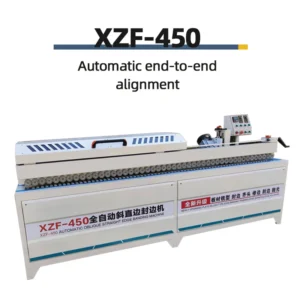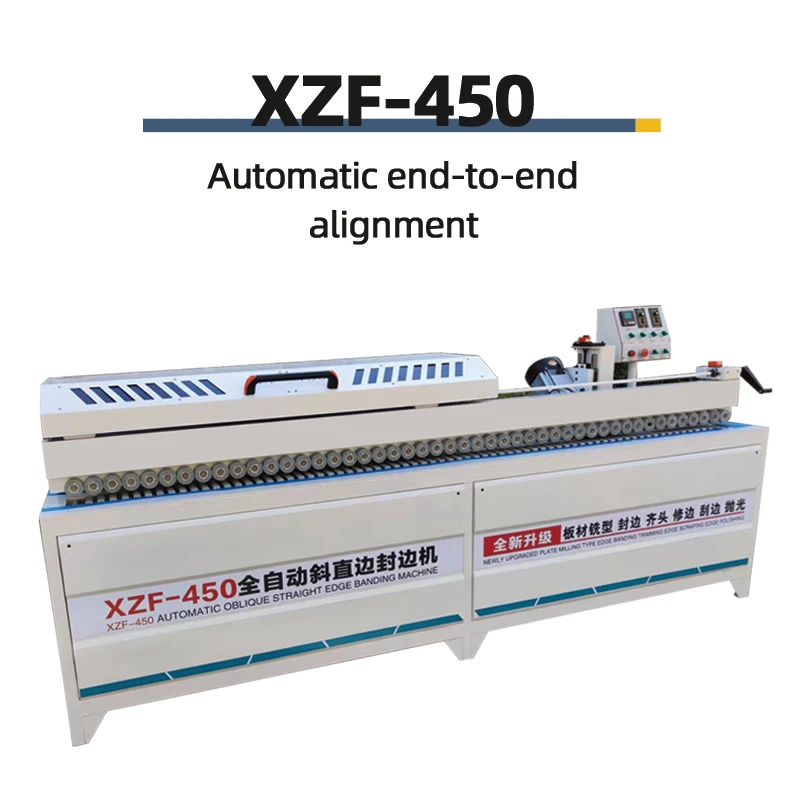
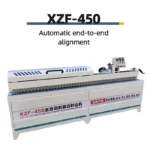
XZF450 Automatic Edge Banding Machine, 9.5 kW, 380V/415V, 0-12 m/min feed — engineered for synchronized panel processing lines with 7 integrated stations from pre-milling through polishing.
Phased line investment supported with engineer-led layout planning, throughput matching per station, and four-stage QC with pre-shipment verification.
In-house line integration — XZF450 edge banding stations are mapped against upstream and downstream equipment before the order is confirmed, preventing feed-height and throughput mismatches.
| Parameter | Value |
|---|---|
| Model | XZF450 |
| Product Type | Automatic Edge Banding Machine |
| Total Installed Power | 9.5 kW |
| Voltage Configuration | 380V / 415V (configurable) |
| Feed Speed Range | 0 – 12 m/min |
| Pre-milling Motor | 4 kW |
| Trimming Power | 2.2 kW × 2 |
| Polishing Power | 0.4 kW × 2 |
| Vacuum Extraction Power | 550 W |
| Edge Banding Height Range | 0 – 50 mm |
| Edge Banding Thickness Range | 0.3 – 3 mm |
| Minimum Sheet Length | 300 mm |
| Minimum Sheet Width | 150 mm |
| Glue Pot Capacity | 4000 ml |
| Air Source Pressure | 0.5 – 0.7 MPa |
| Transmission Power | 180 W |
| Overall Dimensions (L×W×H) | 300 × 65 × 135 cm |
| Net Weight | 430 kg |
| Control Panel Languages | English, Chinese (customizable) |
| Plug Options | EU, USA, AU, UK |
| Key Features | Pre-milling, 30°/45°/60° edge banding, end trimming, rough/fine trimming, scraping, polishing, dust extraction |
| Application | Material or Output |
|---|---|
| Cabinet door edge finishing | MDF, melamine-faced particleboard, PVC edge band |
| Custom furniture panel processing | Plywood, blockboard, veneer banding |
| Polymer door production | Polymer composite panels, ABS edge material |
| Office and residential cabinetry | Chipboard, high-pressure laminate strips |
| Batch panel edging for medium-to-large runs | Solid wood panels, wood-grain PVC |
The machine that runs fastest in isolation is often the one that stalls the entire line.
I spent years on workshop floors watching a new edge bander sit idle because the panel saw upstream could not feed it fast enough, or the boring station downstream jammed every time the conveyor handed off a panel at the wrong height. The edge banding machine production line only performs when every station speaks the same mechanical language — feed height, cycle time, panel dimension range. When those numbers drift, the line develops bottlenecks that no amount of operator skill can fix. A 4 kW pre-milling motor and a 0–12 m/min feed range give the XZF450 the bandwidth to sit between a high-output panel saw and a multi-head boring machine without forcing either to throttle back. But that match only holds if someone checks the interfaces before the crate arrives [NEED_CITE: material flow compatibility between CNC panel saws and edge banders].
A standalone edge bander is judged on edge finish alone. In a full edge banding machine production line, it must also behave as a conveyor link. The XZF450 work table height and feed rail geometry need to align with the outfeed rollers of the upstream panel saw and the infeed guides of the downstream boring or drilling station. Even a few millimetres of misalignment across a 3-metre span causes panels to skew, which then forces the trimming units to compensate and leaves visible witness marks on the edge. We map these interface dimensions in a line-layout drawing before any equipment ships, so the mechanical hand-off is resolved on paper rather than on the factory floor.
Not every furniture factory funds a complete line on day one. Some start with a panel saw and an edge bander, adding boring and hinge-insertion stations as order volume grows. The XZF450 supports that approach because its feed speed range and station count cover both moderate-volume custom work and higher-volume batch runs. When the next phase adds a CNC nesting machine or an automatic return conveyor, the edge bander does not need to be replaced — its throughput ceiling accommodates the added upstream capacity [NEED_CITE: phased capital investment strategies in panel furniture manufacturing].
The 4 kW pre-milling motor is the first signal that this unit is intended for line integration rather than light workshop use. Pre-milling removes the saw-blade tear-out left by the panel saw, and in a line environment where panels arrive continuously, a weak pre-mill forces the feed to slow down or produces chipped edges that fail final assembly. The 0–12 m/min feed range, driven by a 180 W transmission motor, allows the operator to dial the speed to match the output rate of the upstream saw — running too fast starves the glue pot and produces cold joints, running too slow creates a queue that backs up to the cutting station. Dual 2.2 kW trimming motors handle both rough and fine trimming in one pass, which is necessary when the next station downstream expects a finished edge ready for boring. The 0.5–0.7 MPa air pressure requirement should be checked against the existing compressed-air supply to avoid pressure drops when pneumatic clamps on adjacent machines cycle simultaneously.
I once configured a line where the saw outfeed and the edge bander infeed differed by roughly 15 mm in height. Panels caught the lip of the bander’s feed track and stopped, requiring the operator to lift each board by hand. The line ran at a fraction of its rated speed for three weeks before adjustable risers were fabricated locally. The customer had already accepted a delayed shipment of finished cabinets and absorbed penalty charges. That kind of failure does not show up in any single machine’s brochure — it only appears when equipment from different sources is bolted together without a unified layout [NEED_CITE: industrial machinery installation alignment tolerances].
Equipment that leaves a single factory is tested as a system, not as isolated units. The XZF450 is configured alongside the upstream saws and downstream boring machines we recommend, with voltage, frequency, and control-panel language matched across all stations. Four-stage quality control covers incoming components, in-process assembly, finished-product testing, and pre-shipment verification, so the line arrives with documented tolerances rather than promises. Patented cutting mechanisms in the trimming and scraping stations maintain edge consistency across different panel substrates. OEM and private-label options are available when the end customer or distributor requires branded panels. An engineer-led configuration proposal, including a formal quotation, is delivered within 24 hours of receiving the factory layout and production requirements.
To build a layout that actually works on your floor, share the panel materials and dimensions you process most often, the daily volume you need the line to sustain, and the local voltage and frequency at your facility. If you already operate upstream or downstream equipment from another manufacturer, send us the make and model so we can verify interface heights and throughput compatibility. We can also arrange sample processing on your material before you commit to the order.
Q: How does the XZF450 feed speed align with upstream panel saws and downstream boring machines?
A: The 0–12 m/min range is matched against the cycle output of your saw and the infeed rate of your boring station during the layout phase. We calculate throughput per station and confirm the XZF450 sits within the range where neither upstream nor downstream equipment is forced to idle or queue panels.
Q: Can this machine integrate into a line with other equipment brands?
A: Yes. We verify work-table height, feed direction, conveyor speed, and air-pressure requirements against your existing machines. Interface drawings are produced before shipment so mechanical and electrical connections are resolved in advance.
Q: What voltage configurations are available for multi-country factory rollouts?
A: The XZF450 supports 380V and 415V as standard, with plug options for EU, USA, AU, and UK markets. Voltage and frequency are confirmed per facility and documented on the electrical schematic shipped with the machine.
Q: Is phased line investment supported as production volume grows?
A: The layout plan we provide maps future stations such as return conveyors, automatic stacking, or additional boring heads. The XZF450 throughput range accommodates these additions without requiring a machine replacement.
Q: What commissioning and training is included for a full line?
A: Our engineer supervises first-run calibration across all stations, sets glue-pot and trimming parameters for your material, and trains operators on daily adjustments and maintenance routines specific to the installed configuration.
* Detailed technical specifications vary by model. Contact us for the full parameter sheet and customization options.
Heavy-duty wooden crate with moisture-proof lining and steel strapping. Seaworthy standard for safe ocean freight.
Standard models: 15-20 working days. Custom OEM orders: 25-35 working days from deposit confirmation.
FOB Qingdao / Tianjin. EXW, CIF available. T/T, L/C, Western Union accepted. Flexible payment terms for long-term partners.
We export to 100+ countries across Europe (Germany, Spain, Italy), Americas (USA, Mexico, Brazil, Argentina), Southeast Asia (Vietnam, Indonesia, Thailand), Africa (Nigeria, Egypt, South Africa), and the Middle East. Full customs documentation and export compliance support included.
Your logo on machine body, control panel and packaging. Full white-label production available.
Support 110V/60Hz, 220V/50Hz, 380V/50Hz, 440V/60Hz and other local electrical standards.
Modify table size, motor power, cutting capacity and other parameters per your production requirements.
Control panel available in English, Spanish, French, Arabic, Russian and other languages on request.
Custom paint color, machine casing design and aesthetic modifications to match your brand identity.
Bundled tooling sets, spare parts kits, installation tools and custom accessories for your market needs.
Fill in your requirements and our sales team will respond within 24 hours with a formal quotation and full technical specifications.